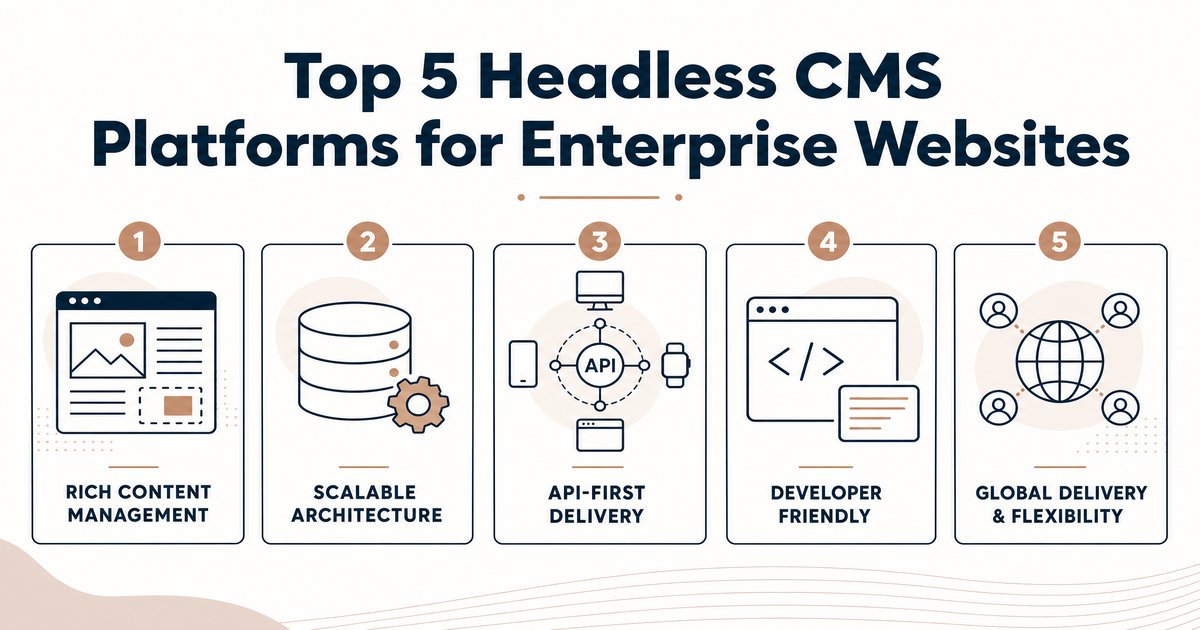
Top 5 Headless CMS Platforms for Enterprise Websites
Introduction
In today’s rapidly evolving digital landscape, enterprises require robust and flexible content management solutions to deliver seamless experiences across diverse channels. Traditional monolithic Content Management Systems (CMS) often struggle to keep pace with the demands of omnichannel delivery, personalized content, and rapid development cycles. This is where headless CMS platforms emerge as a transformative solution. A headless CMS decouples the content backend (where content is stored and managed) from the frontend presentation layer (how content is displayed). This architectural shift empowers businesses to distribute content via APIs to any device or platform, from websites and mobile apps to IoT devices and AI-driven interfaces [1] [2].
For business owners, founders, marketers, and IT professionals, selecting the right headless CMS is a strategic decision that impacts scalability, developer agility, and marketing effectiveness. This article delves into the top 5 headless CMS platforms best suited for enterprise-level websites, examining their key features, pricing models, and respective pros and cons to help you make an informed choice.
1. Contentful
Contentful is a widely adopted and mature headless CMS known for its robust API-first architecture and extensive ecosystem. It is particularly favored by global enterprises that require sophisticated content delivery across multiple channels and languages [3].
Key Features
- Modular Content Modeling: Contentful allows users to break down content into small, reusable components, enabling content to be built once and then reused across various brands, use cases, channels, and regions [3].
- Extensive Integrations Marketplace: With over 100 integrations and plugins, Contentful seamlessly connects with existing tools, including AI content generators, Vercel, Slack, and Microsoft Teams [3].
- Scalability: Its API-first philosophy and cloud-native infrastructure are designed to handle high traffic and dynamic content delivery, supporting a vast choice of microservices for adaptable tech stacks [3].
- Security and Compliance: Contentful offers enterprise-grade security features such as role-based access control, single sign-on (SSO), and audit logs. It is also SOC 2 Type 2, ISO 27001, and HIPAA compliant, with regional data residency options [4].
- Automation: Contentful Studio and native AI Actions facilitate automated translations and content assembly, reducing developer bottlenecks [4].
Pricing
Contentful offers a free tier for up to 10 users, 100,000 API calls/month, and 50 GB/month. Paid plans start around $300/month for the Basic plan, with enterprise pricing being custom and potentially ranging from $60,000 to $140,000+ annually, depending on usage and additional features [3] [4].
Pros and Cons
Pros:
- Maturity and Reliability: A well-established platform with a proven track record for large-scale operations.
- Robust Localization: Excellent support for multi-language and multi-region content delivery.
- Comprehensive Ecosystem: A rich marketplace of integrations and a large partner network.
- Strong Security: High compliance standards and enterprise-grade security features.
Cons:
- Cost Scaling: Pricing can escalate significantly with increased usage, especially for large enterprises.
- Cloud-Only: No self-hosted option, which might be a concern for organizations with strict data sovereignty requirements.
- Rigid Workflows: While robust, some users find its workflows less flexible compared to more customizable platforms [4].
2. Sanity
Sanity distinguishes itself as a
Content Operating System, designed for organizations that treat content as strategic data. It consistently ranks high on G2 lists due to its unique approach to content management [5].
Key Features
- Content Operating System: Sanity treats content as programmable data stored in a schema-less Content Lake, providing rich context for AI agents to automate workflows safely [5].
- Schema as Code: Developers define content models in JavaScript or TypeScript, allowing for version control and customizable editing environments (Sanity Studio) that mirror business workflows [5].
- Real-time Collaboration: Sanity Studio offers real-time collaboration, enabling multiple users and AI agents to work on documents simultaneously without lockouts [5].
- Customization: The open-source React-based Studio allows for extensive customization, making it suitable for enterprises with unique workflow requirements [5].
- AI Readiness: Features like the Content Operations Agent understand specific schema descriptions, facilitating context-aware research and content generation [5].
Pricing
Sanity offers a free tier with generous limits. The Growth plan starts at $15/seat/month, and enterprise pricing is custom [5].
Pros and Cons
Pros:
- Future-Proof Content Foundation: Ideal for organizations preparing for AI-driven operations by treating content as structured data.
- Maximum Schema Flexibility: Developers have extensive control over content models.
- Real-time Collaboration: Enhances team productivity and efficiency.
- Highly Customizable: The open-source Studio allows for tailored editing experiences.
Cons:
- Steeper Learning Curve: Requires strong TypeScript/React developers for full customization, which can be an overhead for some teams.
- Per-Seat Pricing: Enterprise-tier pricing can become costly for very large editorial teams [5].
3. Storyblok
Storyblok excels at bridging the gap between headless architecture and the visual editing needs of marketing teams. It is recognized for its intuitive visual editor and component-based approach [5].
Key Features
- Visual Editor: Provides a WYSIWYG experience where editors can drag and drop components and see a live preview, making content creation less stressful for marketing teams [5].
- Component-Based Approach (Slices): Developers create reusable content components (bloks/slices) that marketers can then assemble to build pages, balancing structure and flexibility [5] [6].
- FlowMotion: Recently launched feature that adds automation and orchestration capabilities powered by n8n, enabling CMS-native workflow automation [6].
- AWS Collaboration: A multi-year collaboration with AWS signals continued enterprise investment and robust infrastructure [6].
Pricing
Storyblok offers an Entry plan starting at $99/month, with enterprise pricing being custom and not publicly published [6].
Pros and Cons
Pros:
- Excellent Visual Editing: Highly intuitive for marketing teams, enabling independent page building.
- Balance of Structure and Flexibility: Component-based approach empowers both developers and marketers.
- Workflow Automation: FlowMotion enhances internal CMS processes.
- Strong Enterprise Investment: Collaboration with AWS indicates future growth and stability.
Cons:
- Presentation-Specific Content: Content can sometimes be tied to presentation-specific blocks, making it harder to reuse across non-web channels [5].
- Limited AI Capabilities: While FlowMotion offers automation, its AI capabilities are not as deeply native or full-stack as some competitors [6].
4. Strapi
Strapi is a leading open-source headless CMS that offers developers absolute control over their infrastructure and data. It is particularly appealing to organizations with strict compliance requirements or a preference for self-hosting [5] [6].
Key Features
- Open-Source and Self-Hosted: Provides complete control over infrastructure and data privacy, allowing deployment on private servers [5] [6].
- Full Customization: Highly customizable at the code level with a large developer community, enabling tailored content models and API structures [6].
- Framework Agnostic: Supports various frontend frameworks, giving developers freedom of choice.
- Managed Cloud Option: Strapi Cloud is available for teams that prefer managed hosting, reducing the burden of self-hosting [6].
Pricing
Strapi’s open-source version is free to self-host. Strapi Cloud starts at $29/month, with enterprise pricing being custom [6].
Pros and Cons
Pros:
- Absolute Control: Ideal for organizations requiring full control over their data and infrastructure.
- Cost-Effective (Self-Hosted): The open-source nature can reduce costs for teams with the technical capacity to self-host.
- Strong Developer Community: Access to a large community for support and resources.
- High Customization: Allows for deep customization to fit specific needs.
Cons:
- DevOps Overhead: Self-hosting requires significant resources for security patching, server maintenance, and upgrades [6].
- Security Responsibility: The team is responsible for managing security and compliance, which can be a challenge for some enterprises [6].
- Limited Native AI: AI capabilities are not as mature or deeply integrated compared to some managed SaaS solutions [6].
5. Hygraph
Hygraph (formerly GraphCMS) is a GraphQL-native headless CMS specializing in content federation. It is designed for enterprises with complex data architectures that need to unify content from multiple sources into a single, high-performance GraphQL API [6] [7].
Key Features
- GraphQL-Native: Built from the ground up with GraphQL, allowing for efficient and precise data fetching, reducing over-fetching and under-fetching issues [7].
- Content Federation: Unifies content from various sources (PIMs, DAMs, remote databases) behind a single content graph, solving data silo problems [6] [7].
- Flexible Content Modeling: Enables combining data and content from multiple systems and making it available through a single GraphQL API endpoint without moving the content itself [7].
- Enterprise-Grade Security: ISO 27001 certified and SOC2 Type 2 compliant, ensuring high data protection standards. Supports sandbox environments for schema changes and multiple backup options [7].
- Scalability: Built on a scalable infrastructure to handle high-traffic scenarios, with content APIs served via a globally distributed edge cache for improved performance and latency [7].
Pricing
Hygraph’s Professional plan starts at $299/month, with enterprise pricing being custom [6].
Pros and Cons
Pros:
- True GraphQL Native: Optimized for GraphQL workflows, offering efficient data querying.
- Content Federation: Excellent for unifying disparate content sources.
- High Scalability: Designed for high traffic and global content delivery.
- Robust Security: Strong compliance and data protection features.
Cons:
- Complexity: Its strength in federation can be an overhead for teams needing a simpler headless CMS [6].
- Limited Native AI: AI capabilities are not as deeply integrated compared to some competitors [6].
Conclusion
Choosing the optimal headless CMS for an enterprise website in 2026 is a strategic decision that requires careful consideration of various factors, including scalability, developer experience, marketer usability, security, and AI readiness. The platforms reviewed—Contentful, Sanity, Storyblok, Strapi, and Hygraph—each offer distinct strengths tailored to different enterprise needs.
- Contentful stands out for its maturity, robust localization, and comprehensive ecosystem, making it ideal for global enterprises with established workflows.
- Sanity is best for organizations that view content as strategic data and seek maximum schema flexibility and AI-driven automation.
- Storyblok is an excellent choice for marketing-heavy teams prioritizing visual editing and intuitive content creation.
- Strapi provides unparalleled control and customization for tech-savvy teams comfortable with self-hosting and managing their infrastructure.
- Hygraph is the go-to solution for enterprises with complex data architectures requiring GraphQL-native content federation.
Ultimately, the best headless CMS for your enterprise will be the one that aligns most closely with your specific business objectives, technical capabilities, and long-term digital strategy. Evaluating these platforms against your unique requirements will ensure you select a solution that empowers your teams to innovate and deliver exceptional digital experiences.
References
- Headless CMS – Top Content Management Systems – Jamstack
- What is a Headless CMS? The Ultimate Guide for Enterprise Retailers
- Best Headless CMS for Enterprise Teams – Agility CMS
- 10 Best Headless CMS Providers for Enterprise Companies (2026) – Prismic
- Top 5 Headless CMS Platforms for 2026 on G2 – Sanity
- Top 7 Enterprise Headless CMS Platforms in 2026 – Cosmic
- Top 7 Enterprise-Ready Headless CMSs in 2026 – Hygraph