How to Use Product-Led Growth to Scale Your SaaS
Introduction: Unlocking Sustainable SaaS Growth with Product-Led Strategies
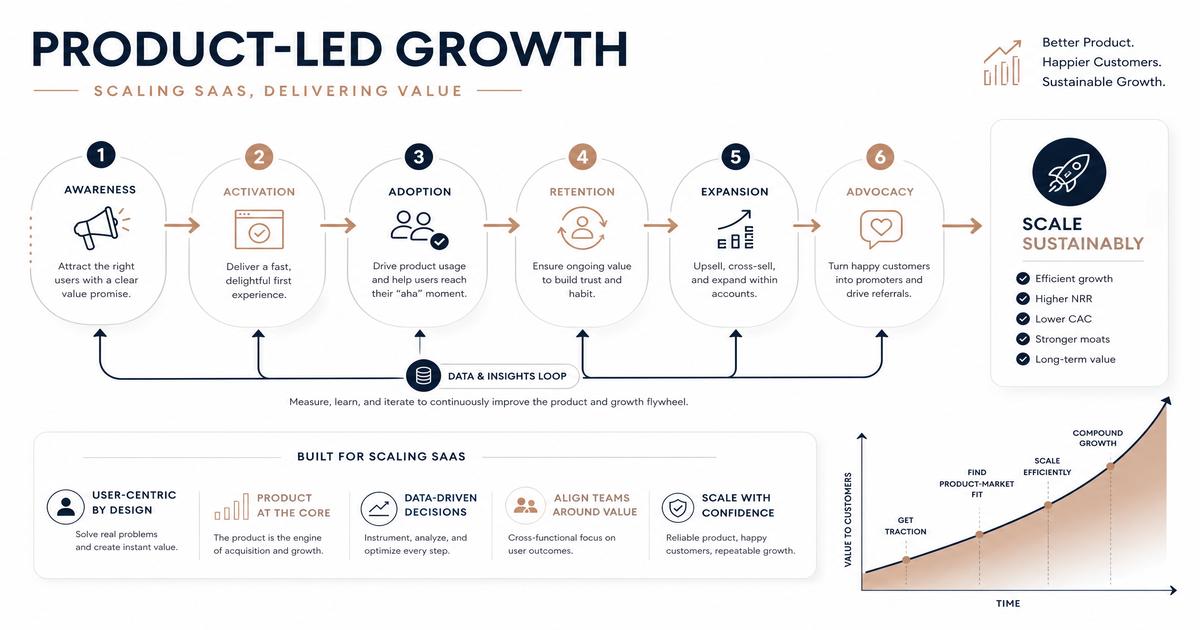
In today’s competitive SaaS landscape, simply having a great product is no longer enough. To achieve sustainable growth and stand out from the crowd, businesses are increasingly turning to **Product-Led Growth (PLG)**. This strategy places the product at the heart of customer acquisition, retention, and expansion, allowing the product itself to drive the entire customer journey. Unlike traditional sales-led or marketing-led approaches, PLG empowers users to experience the value of a product firsthand, fostering organic adoption and advocacy. This guide will walk you through the essential steps to effectively implement PLG and scale your SaaS business.
What is Product-Led Growth (PLG)?
Product-Led Growth is a business methodology where the product serves as the primary driver of growth. Instead of relying heavily on sales teams or extensive marketing campaigns to educate and convert customers, PLG focuses on creating an intuitive, valuable, and self-serve product experience. The core idea is that if your product is good enough, it will sell itself. This approach often manifests through freemium models, free trials, or interactive demos that allow users to quickly grasp the product’s benefits.
Key Principles of PLG:
- Value First: Users should experience immediate value upon using the product.
- Self-Serve: The product should be easy to adopt and use without significant human intervention.
- Delightful Experience: The user experience must be seamless and enjoyable to encourage continued use and advocacy.
- Data-Driven: Product decisions are informed by user behavior data to optimize the journey and identify growth opportunities.
Step-by-Step Guide to Implementing Product-Led Growth
Step 1: Define Your Product’s Core Value and Ideal Customer Profile (ICP)
Before embarking on a PLG strategy, you must have a crystal-clear understanding of what unique value your product offers and who benefits most from it. This involves identifying your **Ideal Customer Profile (ICP)** and the specific problem your product solves for them.
- Identify the “Aha!” Moment: What is the exact point in the user journey where they realize the true value of your product? This “Aha! Moment” should be easily discoverable and repeatable.
- Segment Your Audience: Understand the different user segments and tailor their initial product experience to highlight relevant features and benefits.
- Value Proposition Canvas: Use tools like the Value Proposition Canvas to align your product’s features with customer pains and gains.
Step 2: Optimize for Onboarding and First-Time User Experience (FTUE)
The initial experience a user has with your product is critical for PLG. A smooth, intuitive, and value-driven onboarding process is paramount to converting free users into paying customers.
- Minimize Time-to-Value (TTV): Reduce the steps and time it takes for a new user to reach their “Aha! Moment.”
- Interactive Walkthroughs: Implement in-app tutorials, tooltips, and guided tours that help users navigate key features without feeling overwhelmed.
- Personalization: Offer personalized onboarding flows based on user roles, goals, or industry to make the experience more relevant.
- Remove Friction: Simplify sign-up processes, reduce form fields, and eliminate any unnecessary barriers to entry.
Step 3: Implement a Freemium or Free Trial Model
Offering a free version or a trial period is a cornerstone of many successful PLG strategies. It allows users to experience the product’s value before committing financially.
- Freemium: Provide a perpetually free version with limited features or usage. The goal is to hook users with core functionality and encourage upgrade for advanced capabilities.
- Free Trial: Offer full access to the product for a limited time. Ensure the trial period is long enough for users to experience significant value but short enough to create urgency.
- Clear Upgrade Paths: Make it obvious what additional value users will gain by upgrading to a paid plan. Highlight premium features and benefits within the free experience.
Step 4: Drive Engagement and Retention Through Continuous Value Delivery
PLG isn’t just about acquisition; it’s equally about keeping users engaged and ensuring they continue to derive value from your product over time. High retention rates are crucial for sustainable growth.
- In-App Messaging: Use targeted messages to guide users to new features, offer tips, or provide support.
- Feature Adoption: Monitor which features are being used and encourage exploration of underutilized but valuable functionalities.
- Community Building: Foster a community around your product where users can share tips, ask questions, and provide feedback.
- Regular Updates and Improvements: Continuously enhance your product based on user feedback and market trends to keep it fresh and valuable.
Step 5: Leverage Product Data for Insights and Optimization
Data is the lifeblood of a successful PLG strategy. By analyzing how users interact with your product, you can identify areas for improvement, optimize the user journey, and uncover growth opportunities.
- Key Metrics: Track metrics such as activation rate, feature adoption, daily/monthly active users (DAU/MAU), churn rate, and customer lifetime value (CLTV).
- A/B Testing: Experiment with different onboarding flows, feature placements, and pricing models to see what resonates best with your audience.
- User Feedback: Collect qualitative feedback through surveys, interviews, and in-app prompts to understand user sentiment and pain points.
- Product Analytics Tools: Utilize tools like Mixpanel, Amplitude, or Pendo to gain deep insights into user behavior.
Step 6: Align Sales and Marketing with Your Product-Led Strategy
While the product leads, sales and marketing still play vital roles in a PLG model. Their functions evolve to support and amplify the product’s growth efforts.
- Sales Assist: Sales teams focus on converting high-potential free users or trial users who have already experienced product value. They act as consultants rather than traditional cold callers.
- Marketing Enablement: Marketing efforts shift to driving awareness and adoption of the free product or trial, educating users on its benefits, and nurturing leads through content that highlights product value.
- Shared Goals: Ensure sales, marketing, and product teams are aligned on common goals and metrics, working collaboratively to optimize the entire customer journey.
Conclusion: The Future of SaaS Growth is Product-Led
Product-Led Growth is more than just a trend; it’s a fundamental shift in how SaaS businesses achieve sustainable scale. By prioritizing the user experience and allowing the product to demonstrate its own value, companies can build stronger customer relationships, reduce acquisition costs, and foster organic advocacy. Implementing a PLG strategy requires a deep understanding of your users, continuous product iteration, and a commitment to data-driven decision-making. Embrace these steps, and you’ll be well on your way to scaling your SaaS business effectively and efficiently.
Call to Action:
Ready to transform your SaaS growth strategy? Explore SaaSSync Pro’s comprehensive reviews and comparisons of leading SaaS tools to find the perfect solutions to support your product-led journey.