How to Integrate AI into Your SaaS Product Roadmap
Introduction: Navigating the AI Frontier in SaaS
Artificial Intelligence (AI) is no longer a futuristic concept but a present-day imperative for SaaS companies looking to stay competitive and innovative. Integrating AI into your SaaS product roadmap can unlock new levels of efficiency, personalization, and predictive power, transforming how users interact with your software and how your business operates. This guide provides a practical, step-by-step approach to effectively weave AI capabilities into your SaaS product development, ensuring a strategic and impactful implementation.
Why AI is Essential for Your SaaS Product Roadmap
The SaaS landscape is constantly evolving, driven by user demands for smarter, more intuitive, and highly efficient solutions. AI offers a unique opportunity to meet these demands by automating complex tasks, providing deeper insights, and delivering hyper-personalized experiences. Ignoring AI means risking obsolescence in a market increasingly dominated by intelligent applications.
Enhanced User Experience and Personalization
AI algorithms can analyze vast amounts of user data to understand individual preferences, behaviors, and needs. This allows SaaS products to offer highly personalized recommendations, customized interfaces, and proactive support, significantly enhancing the user experience. For example, an AI-powered CRM can suggest optimal sales strategies based on customer interaction history, or a project management tool can automatically prioritize tasks based on deadlines and team availability.
Improved Efficiency and Automation
Many routine and repetitive tasks within SaaS applications can be automated using AI, freeing up users to focus on more strategic activities. This includes everything from automated customer support chatbots and intelligent data entry to predictive maintenance scheduling and content generation. The result is increased operational efficiency, reduced manual errors, and a more streamlined workflow for your users.
Data-Driven Insights and Predictive Analytics
AI excels at identifying patterns and trends in large datasets that would be impossible for humans to discern. By integrating AI, your SaaS product can offer powerful analytics and predictive capabilities, helping users make more informed decisions. This could involve forecasting sales trends, identifying potential customer churn, or predicting system failures before they occur, providing invaluable foresight to your clients.
Step-by-Step Guide to Integrating AI into Your SaaS Product Roadmap
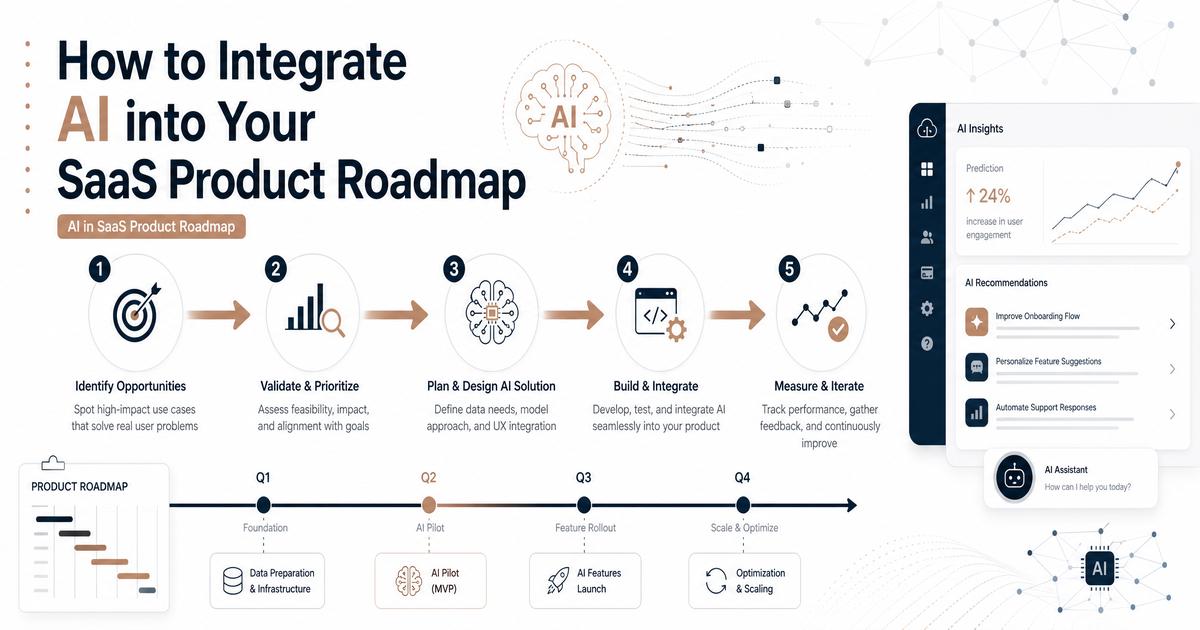
Successfully integrating AI requires a structured approach. Here’s how to do it:
Step 1: Define Your AI Strategy and Objectives
Before diving into technical implementation, clearly articulate what you aim to achieve with AI. Your AI strategy should align with your overall business goals and address specific pain points for your users. Consider the following questions:
- What specific problems can AI solve for our users?
- How will AI enhance our product\’s core value proposition?
- What metrics will we use to measure the success of our AI initiatives?
- What data do we have available, and what data do we need to collect?
Example: A SaaS company offering an email marketing platform might aim to use AI to improve email open rates by predicting optimal send times and personalizing subject lines.
Step 2: Assess Your Data Infrastructure and Readiness
AI models are only as good as the data they are trained on. A robust data infrastructure is crucial for successful AI integration. Evaluate your current data collection, storage, and processing capabilities. Ensure your data is clean, accurate, and accessible. You may need to invest in data warehousing solutions, implement data governance policies, and explore data labeling services.
- Data Quality: Is your data accurate, consistent, and complete?
- Data Volume: Do you have enough data to train effective AI models?
- Data Accessibility: Can your AI systems easily access the necessary data?
- Data Privacy and Security: Are you compliant with regulations like GDPR and CCPA?
Step 3: Identify Key AI Use Cases and Features
Brainstorm specific AI features that will deliver the most value to your users. Start small with pilot projects that have a clear scope and measurable outcomes. Prioritize use cases based on potential impact, feasibility, and alignment with your strategic objectives.
Common AI Use Cases in SaaS:
| Use Case | Description | Example in SaaS |
|---|---|---|
| Natural Language Processing (NLP) | Understanding and generating human language. | Chatbots, sentiment analysis, content summarization. |
| Machine Learning (ML) | Enabling systems to learn from data without explicit programming. | Recommendation engines, fraud detection, predictive analytics. |
| Computer Vision | Enabling computers to \”see\” and interpret visual information. | Image recognition, object detection, facial recognition. |
| Robotic Process Automation (RPA) | Automating repetitive, rule-based tasks. | Automated data entry, invoice processing. |
Step 4: Build or Integrate AI Capabilities
Once you\’ve identified your use cases, you have several options for implementing AI:
- In-house Development: Build AI models and infrastructure from scratch if you have the expertise and resources. This offers maximum control and customization.
- Leverage Cloud AI Services: Utilize pre-built AI services from providers like AWS (Amazon SageMaker, Rekognition), Google Cloud (AI Platform, Vision AI), or Microsoft Azure (Azure Machine Learning, Cognitive Services). This can accelerate development and reduce infrastructure overhead.
- Partner with AI Specialists: Collaborate with external AI consulting firms or integrate third-party AI APIs into your product. This can be a good option for specialized AI tasks or if you lack in-house expertise.
Consider starting with cloud AI services or third-party APIs to validate your concepts quickly before committing to extensive in-house development.
Step 5: Develop, Test, and Iterate
AI integration is an iterative process. Develop your AI features in agile sprints, focusing on continuous testing and refinement. Monitor the performance of your AI models, gather user feedback, and be prepared to iterate based on real-world data.
- Model Training and Evaluation: Continuously train and fine-tune your AI models with new data.
- A/B Testing: Test different AI approaches to determine which performs best.
- User Feedback: Actively solicit and incorporate feedback from your users.
- Performance Monitoring: Implement robust monitoring to track AI model accuracy, latency, and resource consumption.
Step 6: Plan for Scalability and Maintenance
As your SaaS product grows, your AI capabilities must scale with it. Design your AI architecture with scalability in mind, ensuring it can handle increasing data volumes and user loads. Also, establish a clear plan for ongoing maintenance, model retraining, and updates to keep your AI features effective and relevant.
- Scalable Infrastructure: Utilize cloud-native solutions that can automatically scale resources.
- Model Retraining Pipelines: Automate the process of retraining AI models with fresh data.
- Version Control for Models: Implement systems to manage different versions of your AI models.
- Monitoring and Alerting: Set up alerts for performance degradation or anomalies in your AI systems.
Challenges and Considerations
While the benefits of AI are substantial, there are challenges to navigate:
Data Privacy and Ethics
Handling user data for AI purposes requires strict adherence to privacy regulations and ethical guidelines. Transparency with users about data usage and robust security measures are paramount.
Talent Acquisition and Skill Gaps
Finding and retaining skilled AI engineers and data scientists can be challenging. Invest in training your existing team or consider strategic partnerships.
Cost of Implementation and Maintenance
AI development and infrastructure can be expensive. Carefully plan your budget and prioritize AI initiatives that offer the highest ROI.
Conclusion: Embracing an Intelligent Future
Integrating AI into your SaaS product roadmap is no longer an option but a strategic necessity. By following a structured approach—from defining clear objectives and assessing data readiness to iterative development and planning for scalability—SaaS companies can successfully harness the power of AI to create more intelligent, efficient, and user-centric products. The journey requires commitment, continuous learning, and a willingness to adapt, but the rewards in terms of competitive advantage and enhanced user value are immense.
Call to Action
Ready to transform your SaaS product with AI? Start by evaluating your current data infrastructure and identifying one key AI use case that can deliver immediate value. Explore SaaSSync Pro for reviews and comparisons of AI-powered SaaS tools that can jumpstart your integration journey.