How to Choose the Right ERP System for a Manufacturing Business
How to Choose the Right ERP System for a Manufacturing Business
Running a manufacturing business in today’s dynamic global landscape is a complex endeavor. From managing intricate production schedules and vast inventories to overseeing supply chains and ensuring financial health, the challenges are multifaceted. In this environment, an efficient and integrated system is not just an advantage, but a necessity. This is where an Enterprise Resource Planning (ERP) system specifically designed for manufacturing comes into play.
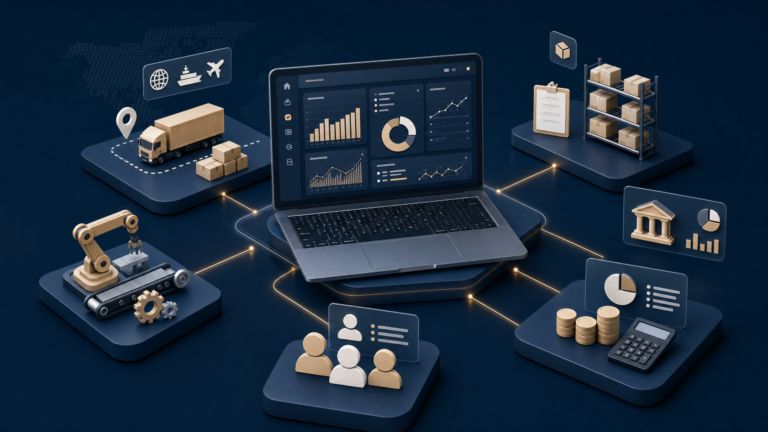
A manufacturing ERP system acts as the central nervous system of your operation, integrating all core business processes into a single, powerful platform. It connects everything from production planning and inventory control to supply chain management and financial reporting, eliminating disconnected systems and manual data entry. The right ERP system empowers manufacturers with real-time visibility, streamlined operations, and enhanced decision-making capabilities [1].
Choosing the right ERP system is a significant strategic decision that can profoundly impact a manufacturing business’s efficiency, profitability, and future growth. A well-selected system can optimize workflows, reduce costs, improve productivity, and provide critical insights. Conversely, a poorly chosen system can lead to costly inefficiencies, implementation failures, and missed opportunities. This comprehensive guide will walk you through the essential steps and considerations for selecting the ideal ERP system for your manufacturing business, ensuring you make an informed decision that drives long-term success.
Understanding Your Business Needs
The first and most crucial step in selecting an ERP system is to thoroughly understand your business’s unique needs, challenges, and aspirations. This foundational analysis will guide your entire selection process, ensuring that the chosen solution aligns perfectly with your operational realities and strategic objectives [2].
Identify Current Pain Points and Future Goals
Begin by identifying where your teams currently experience inefficiencies, duplicate work, lack reliable data, or struggle with accurate reporting. This involves a deep dive into various aspects of your operations:
- Operational Inefficiencies: Look for bottlenecks in production, inventory discrepancies, delays in order fulfillment, or issues with quality control. For example, are you frequently experiencing stockouts or overstocking? Is your production line often halted due to material shortages or machine downtime?
- Financial Challenges: Analyze issues related to inaccurate costing, delayed financial reporting, or difficulties in tracking profitability across different product lines. Are you struggling to get a clear, real-time view of your financial performance?
- Growth Plans and Scalability Requirements: Consider your future growth trajectory. Do you plan to expand product lines, enter new markets, or increase production volume? Your ERP system must be capable of scaling with your business without requiring a complete overhaul in a few years.
Define Key Requirements and KPIs
Once pain points and goals are identified, translate them into concrete requirements and Key Performance Indicators (KPIs) that the new ERP system must address. These can be broadly categorized into functional and non-functional requirements:
- Functional Requirements: These are the specific capabilities the ERP system must possess. For a manufacturing business, these typically include:
- Production Planning and Scheduling: Advanced Planning and Scheduling (APS) capabilities, finite capacity planning, real-time production monitoring.
- Inventory Management and Traceability: Real-time inventory visibility, lot and serial number tracking, mobile data capture for warehouse operations.
- Quality Management: Integrated inspection plans, Non-Conformance/Corrective and Preventive Action (NC/CAPA) workflows, Statistical Process Control (SPC), digital audit trails.
- Financial Management: Robust costing (standard, actual, average), variance analysis, multi-entity consolidation, intercompany eliminations.
- Shop Floor Control: Integration with Manufacturing Execution Systems (MES), real-time data collection from machines.
- Supply Chain Management: Supplier collaboration portals, demand forecasting, procurement automation.
- Business Intelligence and Analytics: Customizable dashboards, real-time reporting, predictive analytics.
- Non-Functional Requirements: These relate to the system’s performance, usability, and security.
- User Experience (UX): Intuitive interface, ease of use for various roles (e.g., shop floor operators, finance personnel).
- Mobile Accessibility: Ability to access the system from mobile devices for field operations or remote management.
- Integration Capabilities: Seamless integration with existing systems like Product Lifecycle Management (PLM), Customer Relationship Management (CRM), and Warehouse Management Systems (WMS).
- Security: Robust data security measures, role-based access control, compliance with industry regulations.
- Measurable Targets for Improvement: Quantify the expected benefits. For example, aim for a 15% increase in throughput, a 20% reduction in Work-In-Progress (WIP) days, or a specific improvement in on-time, in-full (OTIF) delivery rates. These targets will form your ROI baseline [3].
Assemble a Cross-Functional Selection Committee
An ERP selection project impacts every department, so it’s crucial to involve key stakeholders from the outset. Form a cross-functional committee with representatives from:
- Operations
- Finance
- Information Technology (IT)
- Supply Chain
- Quality Assurance
- Sales and Marketing
Ensure executive sponsorship for the project, as this provides authority and reinforces the strategic importance of the initiative. Clearly define governance, decision rights, and a scorecard to evaluate options, ensuring that trade-offs are explicit and tied to the projected Return on Investment (ROI) [2].
Evaluating ERP Options and Features
With a clear understanding of your business needs, the next step is to evaluate the myriad of ERP options available in the market. This involves scrutinizing core features, understanding deployment models, and considering emerging technological trends.
Core Features of Manufacturing ERP Systems
As highlighted in the previous section, a modern manufacturing ERP system offers a comprehensive suite of features. When evaluating potential solutions, pay close attention to how well each system addresses your specific functional requirements:
- Production Planning and Scheduling: Look for systems that offer Advanced Planning and Scheduling (APS) with finite capacity planning, allowing for realistic scheduling that considers labor, tools, and materials simultaneously. The ability to run “what-if” scenarios is also critical for optimizing production [3].
- Inventory Management and Traceability: Real-time inventory visibility, lot/serial control, backward/forward genealogy, and mobile data capture for warehouse execution are essential. Ensure the system supports directed putaway, picks, and cycle counts [1].
- Quality Management: Embedded quality management features, including inspection plans, NC/CAPA workflows, Statistical Process Control (SPC), and digital audit trails, are vital for maintaining product quality and compliance [3].
- Financial Management: Robust costing models (standard, actual, average), variance analysis, and multi-entity consolidation with intercompany eliminations are crucial for accurate financial reporting and control [3].
- Shop Floor Control and MES Integration: The ERP should seamlessly integrate with Manufacturing Execution Systems (MES) to provide real-time monitoring of production progress, OEE (Overall Equipment Effectiveness) metrics, and automated data collection from machines [1].
- Supply Chain Management and Supplier Collaboration: Capabilities for demand forecasting, procurement, and supplier collaboration portals are important for optimizing your supply chain and reducing lead times [1].
- Business Intelligence and Analytics: Look for systems with powerful BI tools that offer customizable dashboards, real-time reporting, and the ability to identify trends and optimize processes [4].
Deployment Options: Cloud vs. On-Premise vs. Hybrid
One of the significant decisions you’ll face is choosing the right deployment model. Each has distinct advantages and disadvantages:
- Cloud ERP: Hosted on the vendor’s servers and accessed via the internet.
- Benefits: Lower upfront costs (subscription-based), automatic updates and maintenance handled by the vendor, remote access from anywhere, reduced IT burden, and easy scalability [1] [4].
- Considerations: Reliance on internet connectivity, potential concerns about data sovereignty and security (though cloud security is constantly improving).
- On-Premise ERP: Installed and managed locally on your own servers and hardware.
- Benefits: Greater control over data and system security, higher customization flexibility, independent operation even without internet access [1] [4].
- Considerations: Higher upfront investment in hardware and software licenses, responsibility for ongoing maintenance and updates, requires internal IT expertise.
- Hybrid Systems: Combine elements of both cloud and on-premise solutions.
- Benefits: Offers a balance of control and flexibility, allowing businesses to keep sensitive data on-premise while leveraging cloud benefits for other functions [4].
- Considerations: Can be more complex to manage and integrate.
The best choice depends on your specific needs, budget, IT resources, and regulatory requirements. Carefully weigh the pros and cons of each model in the context of your business [1].
Technology Trends Shaping ERP in 2026
The ERP landscape is continuously evolving, with new technologies offering significant advancements. Consider systems that embrace these trends:
- Artificial Intelligence (AI): AI is moving beyond pilot projects to deliver practical gains in demand forecasting, inventory optimization, and anomaly detection. Look for AI-assisted scheduling that proposes feasible plans under tight constraints [3].
- Internet of Things (IoT): IoT sensor integration extends visibility from machines to the ERP, driving predictive maintenance, real-time OEE, and automatic production reporting. This enables closed-loop actions and alerts that can trigger work orders or reschedule automatically [3].
- Cloud and SaaS: Cloud and Software as a Service (SaaS) models continue to improve scalability, update cadence, and time-to-value while lowering upfront costs. They offer flexibility and agility for growing businesses [3].
- Security and Compliance: With increasing cyber threats, zero-trust security models, robust encryption, and compliance automation are table stakes. Evaluate these aspects with the same rigor as functional features [3].
Selecting the Right Vendor and Implementation Partner
The success of your ERP implementation hinges not only on the software itself but also on the vendor and the implementation partner you choose. A strong partnership ensures a smooth transition and ongoing support.
Vendor Due Diligence
Thoroughly vet potential ERP vendors based on several critical factors:
- Industry Experience and Specialization: Does the vendor have a proven track record and deep understanding of the manufacturing industry, particularly your specific niche (e.g., discrete, process, or mixed-mode manufacturing)? [2]
- Customization Abilities and Flexibility: While out-of-the-box solutions are often preferred, assess the vendor’s ability to support necessary customizations and integrations without compromising future upgrades.
- Support and Maintenance Offerings: Understand the level of ongoing support, maintenance, and training provided. What are their service level agreements (SLAs)?
- Roadmap and Modularity: Inquire about the vendor’s product roadmap and the modularity of their system. Can you add capabilities (e.g., APS, quality, warehouse) without invasive custom code? [3]
Implementation Process and Support
The implementation phase is critical. A good implementation partner can make all the difference:
- Importance of an Effective Implementation Partner: Choose a partner with extensive experience in manufacturing ERP implementations and a deep understanding of your industry. They should have a clear methodology for project management, data migration, and testing.
- Pre-launch, Launch, and Post-launch Support: Ensure the partner provides comprehensive support throughout all phases of the implementation, including data cleansing, system configuration, user acceptance testing, go-live, and post-go-live hypercare [3].
- Training and Change Management: Adequate training for end-users and a robust change management strategy are essential for successful adoption and to maximize the ROI of your new system [2].
Integration Architecture and Openness
Your ERP system will be at the center of your digital ecosystem. It must integrate seamlessly with other critical business applications:
- APIs, REST, Webhooks: Favor systems with open, well-documented Application Programming Interfaces (APIs), RESTful services, and webhooks for near real-time data flows and seamless integration with PLM, MES, WMS, and CRM systems [3].
- Master Data Governance: Establish clear processes for master data governance, defining ownership, golden records, and synchronization cadence for items, Bills of Material (BOMs), routings, vendors, and customers. Poorly governed master data can torpedo scheduling accuracy and financial integrity [3].
Costing and ROI
An ERP investment is substantial, so a clear understanding of the total cost and expected return is paramount. This involves building a comprehensive Total Cost of Ownership (TCO) model and quantifying the Return on Investment (ROI).
Total Cost of Ownership (TCO)
Beyond the initial software license or subscription fees, consider all components of the TCO over a 3-7 year period:
- Software: Licenses or subscription fees.
- Services: Implementation, consulting, customization, and integration services.
- Infrastructure: Hardware (for on-premise), networking, cloud hosting costs.
- Data Migration: Costs associated with moving data from legacy systems to the new ERP.
- Testing: Resources and time dedicated to system testing and user acceptance testing.
- Training: Costs for training end-users and IT staff.
- Support: Ongoing maintenance, support contracts, and potential upgrades.
Model different scenarios (e.g., single-site vs. multi-site, phased vs. big bang implementation) to understand the financial implications [3].
Return on Investment (ROI)
Quantify the benefits of the ERP system by linking them directly to your defined KPIs:
- Quantifying Benefits: Translate improvements in inventory turns, throughput, scrap reduction, labor efficiency, reduced expedited freight costs, and faster period close into tangible financial gains. Estimate the payback period and overall ROI [3].
- Budgeting for Data Cleansing, Cutover, and Hypercare: Allocate sufficient budget and resources for critical activities like data cleansing (often a hidden critical path), system cutover, and post-go-live hypercare. Data preparation, including items, BOMs, routings, vendors, and customers, requires meticulous planning and validation [3].
Conclusion
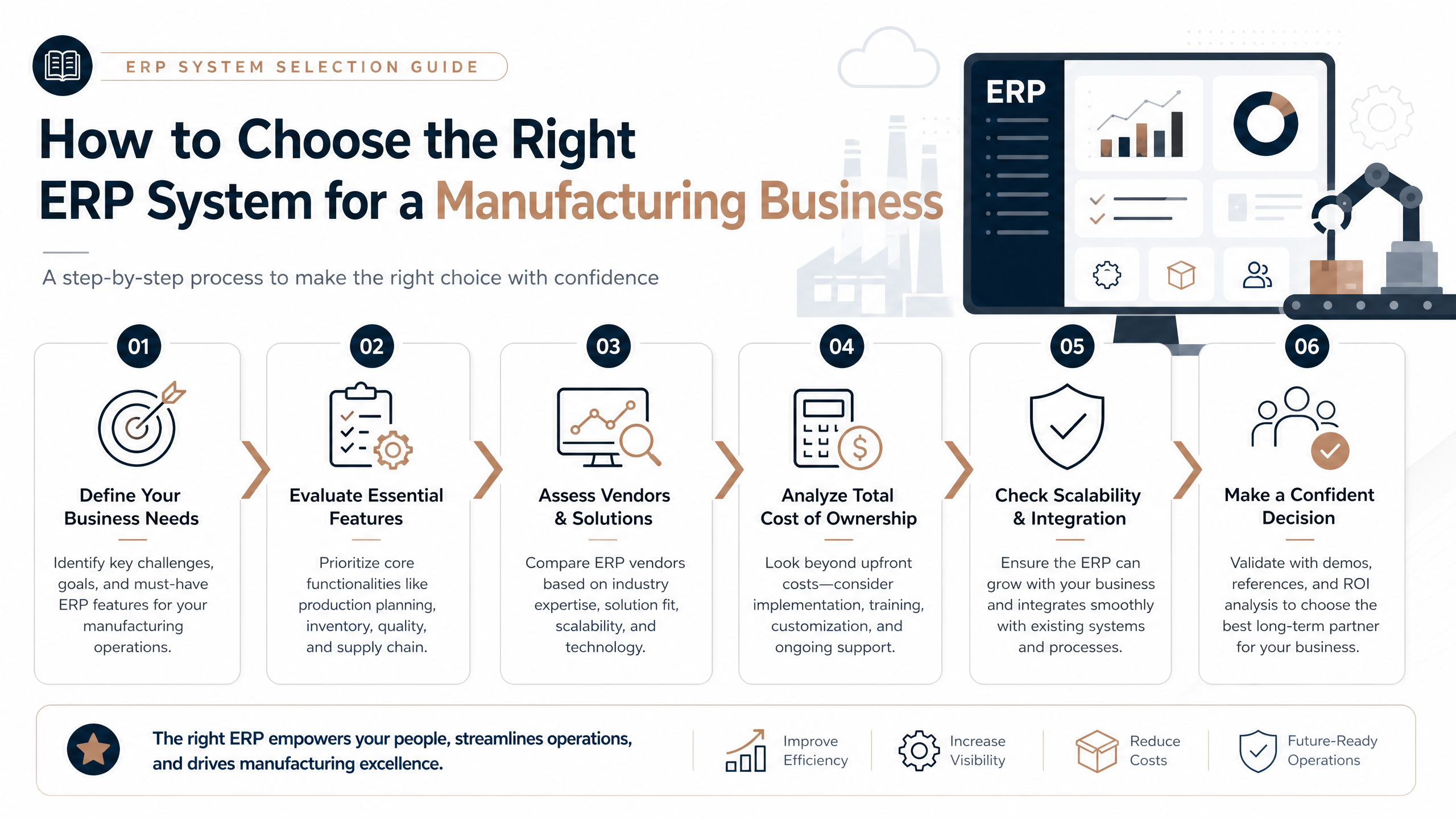
Choosing the right ERP system for a manufacturing business is a strategic journey that demands careful planning, thorough research, and a clear understanding of your organizational needs. It begins with identifying your current pain points and future goals, translating them into concrete requirements, and assembling a dedicated cross-functional team. Subsequently, a meticulous evaluation of ERP options, considering core features, deployment models, and technological trends, becomes paramount.
The selection of a reputable vendor and an experienced implementation partner is equally crucial, ensuring not only the successful deployment of the system but also ongoing support and a clear path for future growth. Finally, a comprehensive understanding of the Total Cost of Ownership and a quantifiable Return on Investment will solidify the business case for this significant investment.
The right ERP system is more than just software; it is a transformative tool that can streamline operations, enhance decision-making, boost productivity, and ultimately drive sustainable growth for your manufacturing business. By following the steps outlined in this guide, you can navigate the complexities of ERP selection with confidence and make a strategic choice that propels your business forward.
Call to Action: Ready to optimize your manufacturing operations? Start your ERP selection journey today and unlock the full potential of your business!
References
- [1] RFgen. (2024, December 27). Manufacturing ERP Software Comparison: Guide to Buying in 2025. Retrieved from https://www.rfgen.com/blog/manufacturing-erp/
- [2] Crowe. (2026, May 14). 5 Steps for Selecting the Right ERP System for Your Business. Retrieved from https://www.crowe.com/insights/netsuite-blog/5-steps-for-selecting-the-right-erp-system
- [3] QAD. (2026, February 18). How to Select the Right ERP System for Your Manufacturing Business in 2026. Retrieved from https://www.qad.com/blog/2026/02/how-to-select-the-right-erp-system-for-manufacturing
- [4] NetSuite. (2025, June 1). What Is Manufacturing ERP Software? A Complete Guide. Retrieved from https://www.netsuite.com/portal/resource/articles/erp/manufacturing-erp.shtml