How to Build a SaaS Trial Onboarding Email Sequence That Converts
How to Build a SaaS Trial Onboarding Email Sequence That Converts
Securing a user’s initial software trial signup is merely the first step in a complex journey toward sustainable revenue growth. For B2B SaaS organizations, the critical inflection point occurs during the trial window, where software adoption and user engagement dictate whether a prospect transitions into a paying subscriber or quietly churns. An effectively architected onboarding email sequence serves as the operational bridge between initial product discovery and enduring customer lifetime value. By delivering targeted, behavior-driven communication, product-led growth companies can systematically guide new users toward realizing core product value without requiring continuous human intervention from customer success teams.
Designing an onboarding email sequence requires a precise balance between educational enablement, behavioral triggers, and commercial pacing. When software buyers evaluate enterprise or mid-market solutions, their cognitive bandwidth is often limited by competing internal priorities and technical integration hurdles. Automated email workflows eliminate friction by surfacing relevant tutorials, highlighting unused feature sets, and reinforcing the overarching business utility of the platform. Consequently, mastering trial onboarding automation is a fundamental competency for revenue leaders seeking to optimize acquisition economics and accelerate time-to-value across diverse customer segments.
Understanding the Anatomy of a SaaS Trial Onboarding Sequence
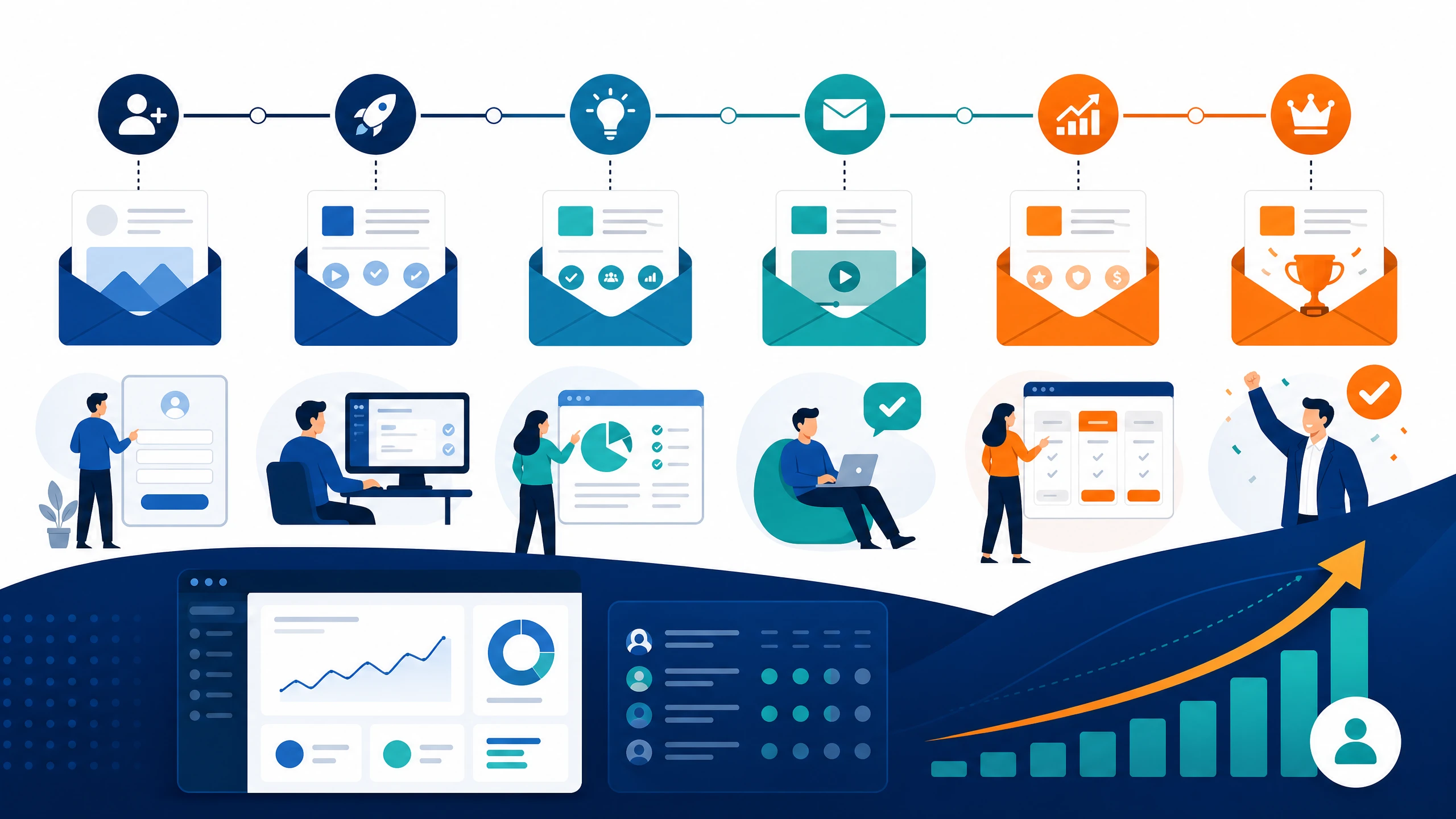
An effective trial onboarding sequence relies on a structured cadence that respects the user’s timeline while maintaining consistent momentum throughout the evaluation period. Unlike traditional consumer marketing campaigns that prioritize promotional discounts, SaaS onboarding communications must focus relentlessly on product utility, workflow integration, and milestone achievement. Every email dispatched during a standard fourteen-day or thirty-day trial must have a distinct operational purpose, ranging from immediate account verification and initial setup guidance to advanced feature adoption and trial expiration alerts.
The structural foundation of a high-converting onboarding workflow begins with immediate engagement upon registration. When a prospective user provisions a new workspace, the initial communication must deliver crystal-clear next steps, credentials access, and a direct pathway to the primary value proposition. Subsequent messages should introduce secondary capabilities incrementally, ensuring that users are never overwhelmed with feature documentation before they have successfully completed foundational setup tasks. By mapping email delivery to actual in-app telemetry and user behavior, SaaS marketing teams can prevent disengagement and preemptively address common abandonment triggers.
| Sequence Stage | Timing Recommendation | Primary Operational Objective | Key Behavioral Trigger |
|---|---|---|---|
| Immediate Welcome | Day 0 (Instant) | Account verification and initial login | Successful workspace creation |
| Core Setup Guide | Day 1 to Day 2 | Completing foundational configuration | Absence of initial data import |
| First Value Milestone | Day 3 to Day 5 | Driving the “Aha!” moment and core usage | Successful completion of first key workflow |
| Advanced Expansion | Day 6 to Day 9 | Introducing collaboration and integrations | Active usage of basic feature set |
| Commercial Conversion | Day 10 to End of Trial | Overcoming buying friction and upgrading | Approaching trial expiration threshold |
Segmenting Users for Personalized Onboarding Workflows
Generic, one-size-fits-all email campaigns consistently underperform because modern B2B SaaS buyers possess vastly different technical requirements, organizational roles, and strategic objectives. A marketing manager evaluating an analytics platform requires a completely different onboarding narrative than a software engineer or a chief financial officer testing the same infrastructure. Effective segmentation ensures that email content aligns precisely with the buyer persona and the specific use case identified during the initial signup questionnaire or onboarding wizard.
Furthermore, advanced SaaS platforms leverage real-time behavioral data to dynamically adjust email cadences based on actual product interaction. If a user completes setup within the first twenty-four hours, the automated workflow should bypass basic configuration guides and immediately introduce advanced reporting or team invitation features. Conversely, if a user exhibits signs of inactivity or encounters setup blockers, the sequence can automatically route them to remedial documentation or offer a targeted consultation with technical support. This level of dynamic personalization transforms automated emails from intrusive noise into indispensable guidance.
Designing Behavioral Triggers and Timing Logic
The timing and trigger mechanics of an onboarding sequence dictate its overall efficacy in driving software adoption and trial conversion. Relying strictly on calendar-based intervals—such as sending an email every forty-eight hours regardless of user action—often results in tone-deaf messaging that alienates active users and frustrates inactive prospects. Modern email automation platforms integrate deeply with customer data platforms and product analytics tools to ensure that messages respond dynamically to user milestones and inactivity thresholds alike.
When establishing timing logic, product and marketing teams must analyze historical user data to identify the precise velocity at which successful cohorts achieve key activation milestones. If data indicates that users who invite at least two team members within their first three days convert at a significantly higher rate, the onboarding sequence must be engineered to incentivize team collaboration immediately following initial account setup. Balancing time-based safety nets with event-driven triggers guarantees that communications remain contextual, highly relevant, and impeccably timed throughout the entire trial lifecycle.
Establishing the Core “Aha!” Moment and Value Realization
The ultimate objective of any B2B SaaS trial onboarding sequence is to accelerate the user’s arrival at the core “Aha!” moment—the exact juncture where the software’s unique value proposition becomes undeniably apparent. In project management software, this might be the creation of a completed sprint board; in financial automation software, it could be the successful reconciliation of a bank feed. The onboarding email sequence must act as a strategic catalyst, removing obstacles and guiding the user toward executing this critical action swiftly and efficiently.
To achieve this, email content should eschew dense theoretical explanations in favor of actionable, bite-sized instructions supported by direct deep links into the application interface. Each message must isolate a single, high-impact action item, providing clear context on why the task matters and how completing it accelerates organizational efficiency. By anchoring the onboarding narrative around tangible value realization rather than superficial feature lists, SaaS organizations build trust, foster long-term engagement, and establish a solid foundation for commercial expansion.
How to Choose and Implement Your Onboarding Email Stack
Selecting the appropriate email automation and customer messaging infrastructure is a critical architectural decision for SaaS organizations scaling their product-led growth motion. Engineering teams and marketing leadership must evaluate whether to build internal notification services or integrate specialized third-party lifecycle marketing platforms that natively support complex event tracking, CRM synchronization, and multi-channel orchestration.
The evaluation process requires a rigorous assessment of several technical and operational criteria to ensure long-term scalability and data integrity across the revenue stack. Organizations must examine the platform’s ability to ingest high-frequency product event streams, execute real-time conditional logic, maintain high deliverability rates across corporate firewall filters, and provide granular attribution reporting linking email interactions to eventual subscription revenue.
+-----------------------------------------------------------------+
|               SaaS Onboarding Stack Evaluation                  |
+-----------------------------------------------------------------+
                                |
        +-----------------------+-----------------------+
        |                                               |
        v                                               v
+-------------------------------+               +-------------------------------+
|     Data Ingestion & Sync     |               |   Automation & Orchestration  |
| - Product telemetry tracking  |               | - Event-driven triggers       |
| - CRM and billing integration |               | - Dynamic content branching   |
| - User attribute mapping      |               | - Multi-channel delivery      |
+-------------------------------+               +-------------------------------+
        |                                               |
        +-----------------------+-----------------------+
                                |
                                v
+-------------------------------+
|     Measurement & ROI         |
| - Trial-to-paid attribution   |
| - Cohort retention analytics  |
| - Deliverability monitoring   |
+-------------------------------+
When implementing the chosen onboarding stack, cross-functional alignment between product management, engineering, and marketing is paramount. Marketing teams must collaborate closely with product analytics engineers to define standardized event nomenclature, ensure robust tracking of user milestones, and establish rigorous testing protocols before deploying automated sequences into production environments. Regular auditing of email performance metrics—including activation rates, feature adoption velocity, and conversion drop-off points—ensures that the onboarding engine continuously adapts to evolving product features and buyer expectations.
Frequently Asked Questions
What is the optimal length for a SaaS trial onboarding email sequence?
The ideal length depends heavily on the complexity of the software product and the duration of the trial period. For standard fourteen-day trials, a sequence consisting of five to seven targeted emails spaced across the timeline typically provides optimal engagement without causing subscriber fatigue. Longer enterprise evaluation cycles spanning thirty days or more may warrant an expanded sequence that introduces advanced capabilities, security documentation, and procurement enablement resources progressively.
How can SaaS companies prevent onboarding emails from landing in spam folders?
Maintaining pristine email deliverability requires strict adherence to technical authentication protocols, including SPF, DKIM, and DMARC configuration across the sending domain. Additionally, SaaS organizations must maintain clean subscriber databases, monitor engagement metrics closely to suppress inactive addresses, and avoid aggressive promotional language or excessive HTML elements that trigger corporate security filters. Ensuring that communications are requested and expected by the recipient during signup is the most effective safeguard against deliverability degradation.
Should onboarding emails continue after a user converts to a paid subscription?
Transitioning a user from a trial state to a paid subscription marks the conclusion of the trial onboarding sequence, but it should immediately trigger a dedicated post-purchase customer success and adoption workflow. Continuing trial-focused messaging after payment has been processed creates confusion and damages brand credibility. Instead, transitioning new subscribers into an ongoing educational and value-reinforcement cadence ensures sustained engagement, minimizes early churn, and nurtures long-term account expansion.
Conclusion
Architecting a high-converting B2B SaaS trial onboarding email sequence requires a disciplined fusion of behavioral data analysis, strategic timing, and value-driven copywriting. By systematically guiding prospective buyers through the friction of initial setup and accelerating their journey toward the core “Aha!” moment, software organizations can dramatically improve trial conversion rates and build sustainable recurring revenue streams. As product-led growth models continue to mature across the technology landscape, refining the onboarding email workflow remains an indispensable strategic imperative for competitive SaaS enterprises.
Editorial Note: Software features, platform integrations, and pricing models referenced in this guide are subject to change. Readers should verify current specifications and pricing details directly on the vendor’s official website before making commercial purchasing decisions.