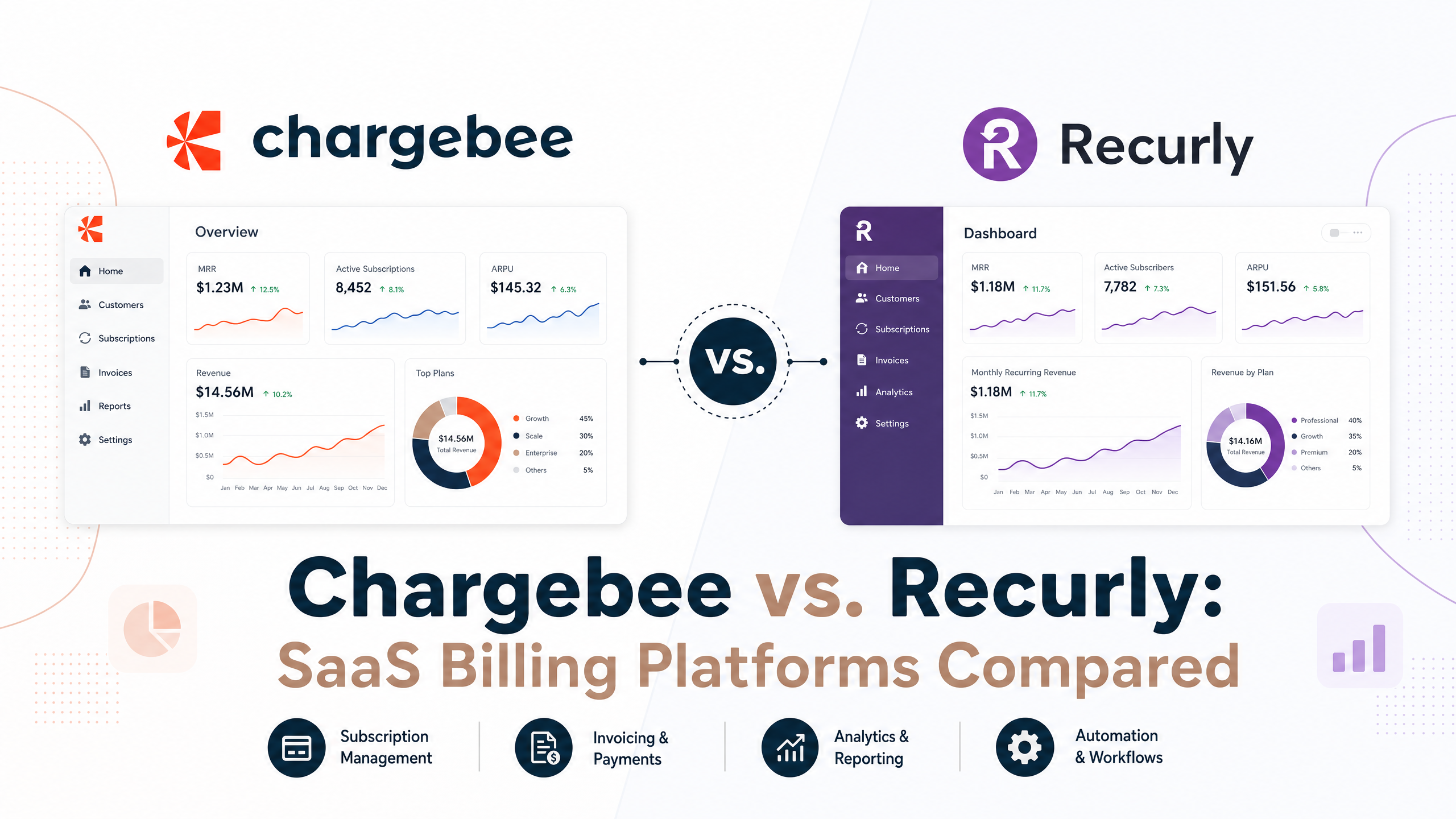
Chargebee vs. Recurly: SaaS Billing Platforms Compared
Introduction
In the dynamic landscape of SaaS, efficient subscription billing and revenue management are paramount for sustained growth. As businesses increasingly adopt recurring revenue models, selecting the right billing platform becomes a critical strategic decision. This article provides a comprehensive comparison of two leading SaaS billing platforms: Chargebee and Recurly. Designed for business owners, founders, marketers, and IT professionals, this analysis aims to shed light on their key features, pricing structures, and overall suitability, helping you make an informed choice for your organization’s unique needs.
Key Features: A Detailed Comparison
Both Chargebee and Recurly offer robust functionalities essential for managing subscription-based businesses. While they share core capabilities, their approaches and strengths often cater to slightly different market segments and operational priorities.
Subscription Management and Billing
Chargebee excels in providing comprehensive tools for flexible billing cycles, discounts, and customizable pricing structures. It supports various billing models, including subscription-based and usage-based, allowing businesses to tailor offerings to diverse customer needs [3]. Its robust API and integration capabilities further enhance its flexibility for custom development and seamless workflow integration [3].
Recurly also offers extensive subscription management and recurring billing features, designed to assist businesses in automating and managing their revenue workflows. It provides a flexible and scalable billing solution that evolves with business growth, with a strong emphasis on reducing churn and optimizing revenue [4].
Payment Processing and Gateways
Chargebee integrates with multiple payment gateways, facilitating seamless payment processing and offering customers various payment options globally. It supports major processors like Stripe, Braintree, and PayPal, ensuring a smooth transaction experience [1].
Recurly distinguishes itself with direct integrations to a broader array of payment gateway partners, and it often keeps essential credit card vaulting tasks in-house. This broad support provides businesses with greater flexibility in choosing their preferred payment processors [2].
Revenue Recognition and Reporting
Chargebee offers advanced tools for managing revenue recognition in compliance with accounting standards such as ASC-606 and IFRS-15, aiding in accurate financial reporting and audit readiness [1] [3]. It also provides insights into key metrics like Monthly Recurring Revenue (MRR) and churn rates through interactive dashboards [3].
Recurly delivers robust revenue recognition capabilities, including automated ASC-606 and IFRS-15 directly within the platform. It also reigns supreme with in-app analytics and benchmarks, providing comprehensive data-backed insights for strategic decision-making [2].
Churn Management and Retention
Chargebee focuses on end-to-end churn management, from cancellations to collections, and helps reduce payment failures. It offers features designed to improve customer retention and grow lifetime value [1].
Recurly is particularly strong in churn prevention, leveraging AI and machine learning to intelligently identify, predict, and retry failed payments at optimal times. This results in improved successful transaction rates and significant revenue recovery, with some reports indicating over $1.3 billion annually recovered [2].
Pricing: Understanding the Cost Structures
Both Chargebee and Recurly employ tiered pricing models, but their transparency and cost implications can vary significantly as businesses scale.
Chargebee Pricing
Chargebee’s pricing includes various plans such as Starter, Performance, and Enterprise. The Starter plan may offer a free tier up to a certain cumulative billing threshold (e.g., $250,000), after which a percentage-based fee (e.g., 0.75%) applies to all revenue above that amount [3]. The Performance plan, typically around $599/month, includes revenue up to a certain MRR (e.g., $100,000), with overage fees kicking in beyond that [3]. Enterprise plans are custom-quoted.
A common concern with Chargebee’s pricing is the potential for unpredictable costs due to overage charges and add-ons. Essential features like advanced dunning (Retention add-on) and comprehensive revenue recognition (RevRec) often come with additional costs or are gated behind higher-tier plans, making budget forecasting challenging for some businesses [3].
Recurly Pricing
Recurly also offers tiered plans, including Starter, Professional, and Elite. Publicly available pricing is generally for its lower tiers. For instance, a Starter plan might include an initial period with no platform fee, followed by a monthly fee (e.g., $249/month) plus volume-based fees (e.g., 0.9% of billing) [1]. Some sources indicate a core plan starting around $99/month with transaction fees [14].
Professional and Elite plans typically require a custom quote, tailored to the business’s specific requirements [1] [4]. Recurly’s pricing can also involve additional costs for advanced features and percentage fees per transaction [15]. While both platforms aim to scale with businesses, their fee structures necessitate careful evaluation to avoid unforeseen expenses.
Pros and Cons: A Balanced Perspective
Choosing between Chargebee and Recurly involves weighing their respective strengths and weaknesses against specific business requirements.
Chargebee
- Pros:
- Robust Subscription Management: Comprehensive tools for flexible billing cycles, discounts, and pricing [3].
- User-Friendly Interface: Praised for its intuitive design and ease of use [4].
- Strong API and Integrations: Extensive third-party integrations and API access for custom development [3].
- Global Capabilities: Well-suited for multi-entity B2B businesses with a global footprint [1].
- Advanced Revenue Recognition: Strong RevRec features for compliance and financial accuracy [1] [3].
- Cons:
- Complex Pricing: Overage fees and add-ons can lead to unpredictable and high costs as revenue scales [3].
- Setup Complexity: Initial setup and integration can be challenging and resource-intensive [3].
- Customer Support: Some users report varying quality of support, with longer wait times for lower-tier plans [3].
- Migration Difficulty: Moving historical data away from the platform can be complex [3].
Recurly
- Pros:
- Churn Prevention: Advanced AI/ML-driven dunning management for revenue recovery [2].
- Broad Payment Gateway Support: Direct integrations with a wide array of payment gateways [2].
- Strong Analytics: Robust in-app subscription analytics and benchmarks [2].
- Flexibility and Scalability: Designed to scale with businesses and adapt to various subscription models [4].
- Developer-Friendly API: Noted for its ease of use for developers [4].
- Cons:
- Limited Customization: Some users find customization options less extensive compared to Chargebee [4].
- Pricing Transparency: Detailed pricing for higher tiers is often not publicly disclosed [4].
- Focus on Consumer Subscriptions: While supporting SaaS, its strengths are often highlighted for consumer-facing subscription businesses [2].
Conclusion: Making the Right Choice
Both Chargebee and Recurly are powerful subscription billing platforms, each with distinct advantages. The optimal choice largely depends on a business’s specific needs, scale, and strategic priorities.
Choose Chargebee if: Your business requires extensive customization for complex B2B pricing models, has a global presence with multiple entities, and prioritizes robust revenue recognition features. Be prepared to carefully manage potential overage costs and factor in resources for initial setup.
Choose Recurly if: Your primary concern is maximizing customer retention through advanced churn prevention, you need broad payment gateway flexibility, and value strong in-app analytics for data-driven decisions. Recurly might be particularly appealing for consumer-facing subscription businesses or those seeking a more developer-friendly API.
Ultimately, prospective users should conduct a thorough evaluation, ideally leveraging free trials or demos, to assess how each platform aligns with their operational workflows, financial forecasting, and growth objectives. Understanding the nuances of their pricing models and feature sets is crucial for selecting a SaaS billing platform that will truly empower your business for long-term success.
References
- Chargebee vs. Recurly – Chargebee Official Comparison
- Recurly vs. Chargebee – Recurly Official Comparison
- Chargebee Review 2026: Features, Pricing, Pros & Cons – Unibee.dev
- Chargebee vs Recurly: Updated comparison [2024] – Hyperline.co
- Recurly pricing, features and reviews: All you need to know – Loopwork.co
- Recurly pricing – is it worth the cost? – Orb Billing