Best Marketing Automation Tools for B2B SaaS Companies
Introduction: Powering Growth with Marketing Automation in B2B SaaS
In the dynamic landscape of Business-to-Business (B2B) Software as a Service (SaaS), customer acquisition, nurturing, and retention are paramount. The sheer volume of tasks involved—from lead generation and email campaigns to customer onboarding and churn prevention—can quickly overwhelm even the most dedicated marketing teams. This is where marketing automation steps in as a transformative solution. By streamlining repetitive processes and enabling personalized engagement at scale, marketing automation tools empower B2B SaaS companies to optimize their marketing efforts, enhance customer experiences, and ultimately drive sustainable growth.
Choosing the right marketing automation platform is a critical decision that can significantly impact a company’s efficiency and revenue. The ideal tool should not only align with a company’s tech stack and team size but also support its revenue goals. Key features to consider include robust email campaign automation, sophisticated lead scoring and segmentation capabilities, comprehensive analytics and reporting, seamless CRM integration, and scalability to accommodate future growth.
This article delves into some of the best marketing automation tools available for B2B SaaS companies in 2026. We will explore their core functionalities, highlight their strengths and weaknesses, and identify their ideal use cases, providing a practical guide to help you select the perfect engine to fuel your growth.
Top Marketing Automation Tools for B2B SaaS Companies
1. HubSpot Marketing Hub
HubSpot Marketing Hub stands out as an all-in-one platform meticulously designed to manage the entire marketing funnel. Its core strength lies in its native integration with the powerful HubSpot CRM, providing a unified source of truth for customer data. This integration fuels sophisticated automation across various channels, including email, ads, landing pages, and website personalization, making it an indispensable tool for B2B SaaS teams aiming to align their sales and marketing efforts without the complexity of managing multiple disconnected systems.
The platform offers a comprehensive suite of features, scaling from a generous free plan suitable for startups to enterprise tiers with advanced functionalities. A standout feature for SaaS companies is its visual workflow builder, which enables marketers to construct intricate, multi-channel customer journeys. These journeys can be triggered by user behavior, lifecycle stage, or specific CRM properties. For instance, a trial user who hasn’t activated a key feature can automatically be enrolled in an email sequence while simultaneously being added to a social media ad audience for re-engagement.
Key Features and Considerations:
- Best For: B2B SaaS companies that require a unified CRM and marketing automation platform and value a clear upgrade path.
- Pricing: Starts with a free plan. Paid tiers (Starter, Professional, Enterprise) are priced based on the number of marketing contacts, which can become costly as the list grows.
- Pros: Deeply integrated with its own CRM, offers a vast app ecosystem, and provides robust attribution reporting at higher tiers to demonstrate ROI.
- Cons: Contact-based pricing can escalate quickly, and mandatory onboarding fees for Professional and Enterprise plans represent a significant upfront investment.
2. Salesforce Marketing Cloud Account Engagement (Pardot)
Salesforce Marketing Cloud Account Engagement, widely recognized by its former name Pardot, is a premium B2B marketing automation platform tailored for organizations deeply embedded within the Salesforce ecosystem. Its primary differentiator is its native, bidirectional synchronization with Salesforce CRM, fostering unparalleled alignment between sales and marketing teams. This makes it one of the most potent SaaS marketing automation tools for companies that leverage Salesforce as their central repository for customer data and demand sophisticated lead management, nurturing, and comprehensive ROI reporting.
Pardot excels in facilitating complex, account-based marketing (ABM) strategies and managing the often-extended sales cycles typical in B2B SaaS. Its Engagement Studio empowers marketers to construct dynamic journeys that adapt based on prospect interactions and sales activities recorded within the CRM. For example, if a SaaS trial user’s engagement score increases after viewing a pricing page, the assigned sales representative in Salesforce can be automatically notified, and the prospect can be added to a targeted nurture path. This tight integration ensures that marketing actions directly inform sales conversations with relevant, timely context.
Key Features and Considerations:
- Best For: Enterprise B2B SaaS companies fully committed to the Salesforce CRM that necessitate deep sales alignment and advanced attribution.
- Pricing: Premium pricing with tiers determined by features and automation capabilities. All plans require an annual contract, signifying a substantial investment.
- Pros: Best-in-class, native Salesforce CRM integration, mature B2B marketing analytics and ROI dashboards, and powerful lead scoring and grading models.
- Cons: The platform is inherently complex to set up and govern effectively, often requiring specialized expertise. Its premium cost and annual commitment render it less accessible for smaller businesses.
3. Adobe Marketo Engage
Adobe Marketo Engage is an enterprise-grade platform built to handle complexity, positioning it as one of the most powerful SaaS marketing automation tools for large organizations with sophisticated go-to-market strategies. Its core strength lies in its exceptionally flexible data model and extensive automation capabilities, which facilitate intricate lead and account-based lifecycle management. Marketo is designed for B2B SaaS teams that need to orchestrate complex buyer journeys, manage multiple business units, and require robust governance and API scalability.
The platform excels at detailed lead and account scoring, powerful segmentation, and dynamic content personalization that can be precisely tailored to very specific audience attributes. For SaaS companies with mature marketing operations, Marketo’s advanced features, such as multi-touch attribution and Journey Analytics (available in upper tiers), provide profound insights into revenue impact. A global SaaS company, for instance, can leverage Marketo to run parallel lead nurturing streams for diverse product lines and geographical regions, each with unique scoring models, while maintaining a centralized, governable database.
Key Features and Considerations:
- Best For: Enterprise B2B SaaS companies with dedicated marketing operations teams that demand deep customization and scalability.
- Pricing: Pricing is not publicly listed and necessitates a custom quote, reflecting its enterprise focus. It is generally considered a premium-priced solution.
- Pros: Highly flexible data model and automation logic, a strong ecosystem of integrations and partners, and advanced account-based marketing (ABM) features.
- Cons: The platform’s complexity mandates dedicated administrative or operational resources for effective management, and the lack of transparent pricing complicates initial evaluation.
4. ActiveCampaign
ActiveCampaign positions itself as a customer experience automation platform, seamlessly integrating email marketing, marketing automation, and a lightweight CRM. It presents itself as a powerful choice among SaaS marketing automation tools for Small to Medium Business (SMB) and mid-market SaaS teams that require sophisticated automation capabilities without the prohibitive enterprise price tag. Its core strength lies in its intuitive visual automation builder, which facilitates the creation of intricate workflows complete with branching logic, site tracking, and event-based triggers. This makes it particularly well-suited for product-led growth strategies and behavior-driven communication.
For SaaS companies, ActiveCampaign excels at crafting highly personalized customer journeys. Marketers can easily construct automations that score leads based on trial engagement, website visits, or specific actions within the product. This level of detail allows for targeted messaging and nurturing, ensuring that each lead receives relevant communications designed to move them further down the sales funnel. The platform’s ability to combine email, marketing automation, and CRM functionalities in a single, user-friendly interface simplifies operations and enhances the overall customer experience.
Key Features and Considerations:
- Best For: SMB and mid-market SaaS teams seeking sophisticated automation capabilities without an enterprise-level investment, particularly those focused on product-led growth.
- Pricing: Offers various plans with pricing based on features and contact list size, generally more accessible than enterprise solutions.
- Pros: Powerful visual automation builder, strong personalization capabilities, integrated CRM, and a good balance of features for its price point.
- Cons: While it includes a lightweight CRM, it may not be as robust as dedicated enterprise CRMs for highly complex sales processes.
5. SMASHSEND
SMASHSEND is an email marketing and lifecycle automation platform engineered specifically for B2B SaaS companies, particularly those in the $1M–$30M Annual Recurring Revenue (ARR) range. It transcends standard newsletters, strategically positioning email as a direct and predictable revenue driver. The platform integrates a powerful, AI-driven email editor with behavioral automation, transactional email support, and a lifecycle CRM, thereby creating a unified system for activating, retaining, and expanding customer accounts.
What truly distinguishes SMASHSEND is its unwavering focus on revenue outcomes and deliverability. The platform is purpose-built to execute high-leverage SaaS playbooks, including onboarding sequences, failed payment recovery, and churn win-back campaigns. The company asserts that it can assist users in adding an additional 10–30% to their ARR by optimizing these critical flows, making it one of the most ROI-centric SaaS marketing automation tools available. Its AI-powered email editor, leveraging advanced models like GPT-5, Claude, and Gemini, significantly accelerates campaign creation, from generating high-performing subject lines to crafting entire email bodies.
Key Features and Considerations:
- Best For: B2B SaaS companies in the $1M–$30M ARR range that prioritize revenue outcomes, strong email deliverability, and AI-driven content creation.
- Pricing: Pricing is not publicly disclosed; however, it offers a free signup path and a growth audit to help teams assess its suitability.
- Pros: Laser focus on SaaS revenue funnels, robust deliverability features (dedicated IP pools, automated warm-up), and an advanced AI email editor.
- Cons: SOC2 compliance is still in progress, and the transactional email API is currently in BETA, which might be a consideration for companies with stringent security requirements or high-volume transactional needs.
6. Encharge
Encharge adopts an integrated approach to marketing automation, designed to work seamlessly with best-in-class tools. Unlike all-in-one solutions that attempt to be everything for everyone, Encharge focuses on deep native integrations with leading platforms such as Segment.com, Stripe, Facebook Ads, Typeform, Intercom, HubSpot, Webhooks, Events API, Salesforce, and Zapier. This strategy allows businesses to leverage their existing tech stack while enhancing their marketing automation capabilities.
The platform features an intuitive visual flow builder that provides contextual data, including email and form previews, and step metrics, simplifying the creation of complex customer journeys. Encharge also excels in creating precise segments with just a few clicks, enabling highly targeted marketing efforts. Starting at an affordable $49/month for 2,000 contacts, Encharge presents itself as one of the most cost-effective marketing automation tools offering such a high level of integration and functionality. It also provides free concierge services for SaaS startups, assisting them in building effective marketing automation without extensive trial and error.
Key Features and Considerations:
- Best For: Early to mid-stage SaaS companies seeking integrated marketing automation that complements their existing best-in-class tools and offers strong segmentation capabilities.
- Pricing: Starts at $49/month for 2,000 contacts, making it one of the more affordable options for its feature set.
- Pros: Affordable pricing, user-friendly visual flow builder, strong native integrations, precise segmentation, and free concierge services for startups.
- Cons: While it integrates with many tools, it may not offer the same depth of native features as some all-in-one platforms for every marketing function.
Key Features to Consider When Choosing a Marketing Automation Tool
Selecting the optimal marketing automation tool for a B2B SaaS company involves a careful evaluation of several key features. These functionalities ensure that the chosen platform can effectively support and scale with your business objectives:
Email Campaign Automation
Email remains a cornerstone of B2B SaaS marketing. A robust automation tool should offer advanced email campaign capabilities, including:
- Trigger-based emails: Automatically send emails based on user actions (e.g., sign-up, feature usage, trial expiration).
- Personalization: Dynamic content insertion to tailor messages to individual recipients based on their data and behavior.
- A/B testing: Tools to test different subject lines, content, and calls-to-action to optimize engagement and conversion rates.
- Scheduling and optimization: Features to schedule emails for optimal delivery times and adjust based on recipient time zones.
Lead Scoring and Segmentation
Effective lead management is crucial for B2B SaaS. The ability to score and segment leads ensures that marketing and sales efforts are focused on the most promising prospects:
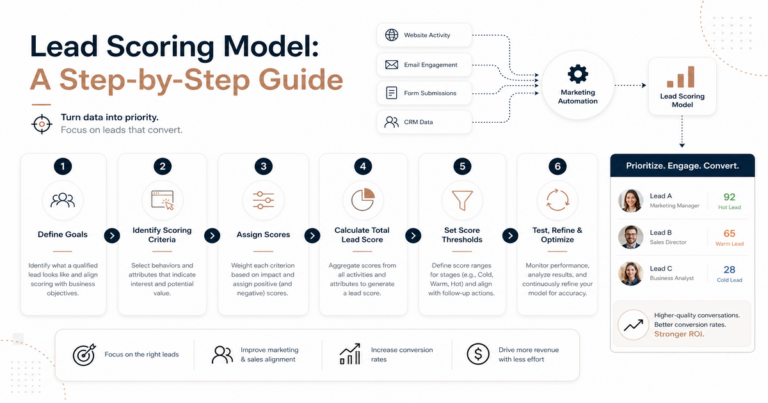
- Lead scoring: Assigning numerical values to leads based on their engagement, demographic information, and fit, helping prioritize sales outreach.
- Behavioral segmentation: Grouping leads based on their interactions with your website, product, and marketing materials.
- Demographic segmentation: Categorizing leads by company size, industry, role, and other relevant B2B criteria.
- Dynamic lists: Automatically updating segments as lead data or behavior changes.
Analytics and Reporting
Data-driven decision-making is vital for optimizing marketing performance. A comprehensive marketing automation platform should provide:
- Performance dashboards: Real-time insights into campaign effectiveness, email open rates, click-through rates, and conversion metrics.
- ROI tracking: The ability to attribute revenue to specific marketing activities and campaigns.
- Customizable reports: Flexibility to create tailored reports that align with specific business goals and KPIs.
- A/B testing results: Clear reporting on the outcomes of A/B tests to inform future campaign strategies.
CRM Integration
Seamless integration with a Customer Relationship Management (CRM) system is essential for aligning sales and marketing teams and ensuring a unified view of the customer journey:
- Bidirectional data sync: Real-time synchronization of lead and customer data between the marketing automation platform and the CRM.
- Sales alerts: Automated notifications to sales teams when leads reach a certain score or engage in specific high-value actions.
- Unified customer profiles: A single, comprehensive view of each customer, encompassing all interactions and data points from both marketing and sales.
Scalability
As a SaaS company grows, its marketing automation needs will evolve. The chosen tool should be able to scale alongside the business:
- Flexible pricing models: Plans that can accommodate increasing contact lists and usage volumes without prohibitive costs.
- Feature expansion: The ability to unlock more advanced features as the business matures and requires more sophisticated automation.
- API and webhook support: Capabilities to integrate with other tools and custom solutions as needed.
Conclusion: Choosing Your Growth Engine
The selection of a marketing automation tool is a strategic decision for any B2B SaaS company. The right platform can transform your marketing efforts, enabling personalized engagement at scale, optimizing lead nurturing, and providing invaluable insights into campaign performance. From all-in-one powerhouses like HubSpot and Salesforce Pardot to specialized solutions like SMASHSEND and ActiveCampaign, each tool offers a unique blend of features designed to address specific business needs and growth stages.
When making your choice, consider your company’s current size, growth trajectory, existing tech stack, and the complexity of your marketing and sales processes. Prioritize tools that offer robust email automation, intelligent lead scoring and segmentation, comprehensive analytics, seamless CRM integration, and the scalability to support your future ambitions. By carefully evaluating these factors, you can select a marketing automation partner that not only streamlines your operations but also becomes a powerful engine for sustained growth.
For more in-depth reviews, comparisons, and expert insights into the world of SaaS tools, visit SaaSSync Pro – your independent guide to navigating the SaaS landscape.