Best Influencer Marketing Platforms for E-commerce Brands: A Comprehensive Guide for 2026
Introduction
In the rapidly evolving landscape of digital commerce, influencer marketing has emerged as a pivotal strategy for e-commerce brands seeking to expand their reach, build authentic connections, and drive sales. As consumers increasingly turn to trusted voices for product recommendations, the ability to effectively partner with influencers has become a significant competitive advantage. However, navigating the complexities of influencer discovery, campaign management, content approval, and performance tracking can be a daunting task without the right tools. This article delves into the best influencer marketing platforms specifically designed for e-commerce brands, offering a comprehensive guide for business owners, founders, marketers, and IT professionals looking to optimize their influencer strategies.
What to Look for in an Influencer Marketing Platform for E-commerce Brands
Choosing the ideal influencer marketing platform for an e-commerce business requires careful consideration of several critical factors. Not all platforms are created equal, and the “best” choice often depends on a brand’s specific needs, budget, and existing tech stack. Key considerations include robust discovery tools, seamless e-commerce integrations, comprehensive campaign management features, and transparent pricing models.
Key Features
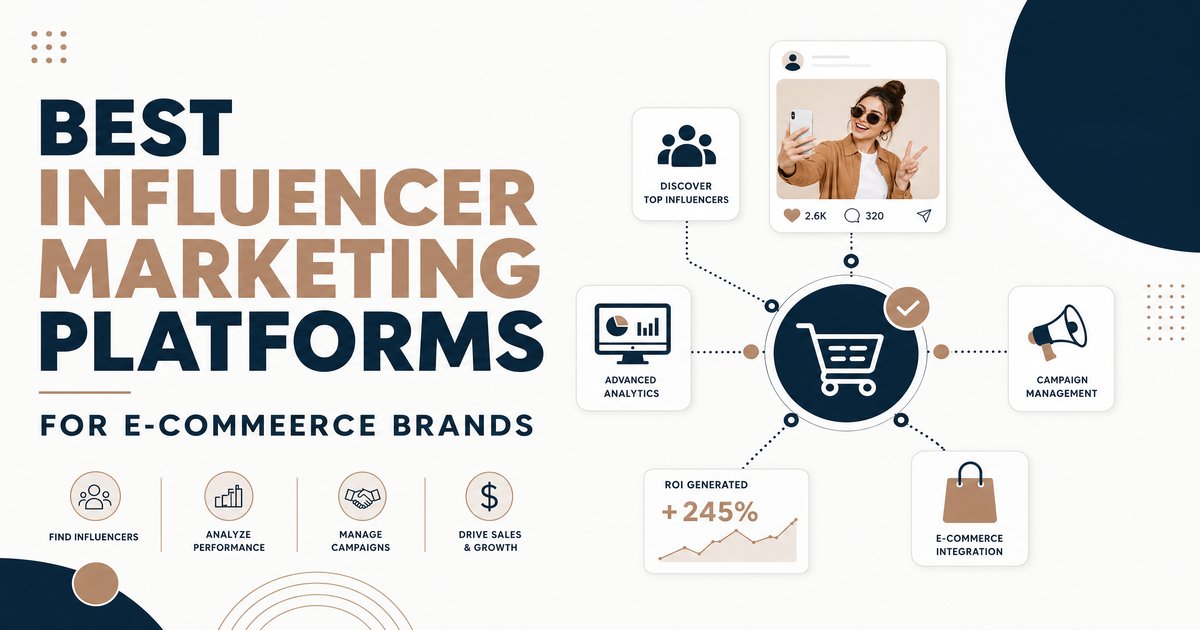
Effective influencer marketing platforms for e-commerce should offer a suite of features that streamline the entire campaign lifecycle. These typically include:
- Influencer Discovery and Vetting: Advanced search filters allowing brands to find creators based on niche, audience demographics, engagement rates, and platform. The ability to vet influencers for authenticity and brand alignment is crucial.
- UGC Sourcing and Content Licensing: Tools to facilitate the commissioning of user-generated content (UGC), secure content files, and manage licensing rights for paid ad usage. This is increasingly important for brands leveraging influencer content in their broader marketing efforts [1].
- Campaign Management: Features for creating detailed campaign briefs, managing communication with influencers, tracking deliverables, and approving content. This centralizes workflows and reduces administrative overhead.
- E-commerce Integrations: Direct integrations with popular e-commerce platforms like Shopify, WooCommerce, and BigCommerce. These integrations enable automated product seeding, discount code generation, affiliate link tracking, and seamless sales attribution [2].
- Performance Tracking and Analytics: Robust dashboards that provide real-time data on campaign performance, including reach, impressions, engagement, conversions, and return on investment (ROI). The ability to attribute sales directly to individual influencers is paramount for measuring effectiveness [2].
- Automated Outreach and Relationship Management: Tools for automating email sequences, managing influencer relationships (CRM), and tracking the pipeline of collaborations. This helps scale outreach efforts while maintaining personalized communication.
- Payment Management: Streamlined processes for managing payments to influencers, including escrow services and automated commission payouts.
Pricing Models
Influencer marketing platforms typically employ various pricing structures, and understanding these models is essential for budget planning:
- Monthly/Annual Subscription: A flat fee for access to the platform’s features, often tiered based on the number of users, campaigns, or influencers managed. This model is common for platforms offering comprehensive suites of tools.
- Pay-Per-Collaboration: Brands pay only when they hire a creator or execute a specific collaboration. This model is often found in creator marketplaces and can be ideal for brands testing influencer marketing for the first time, offering lower financial risk [1].
- Performance-Based Pricing: Payments are tied to the results generated by influencers, such as sales or conversions. This model aligns the platform’s cost directly with campaign success.
- Custom/Enterprise Pricing: Tailored pricing plans for larger brands with extensive needs, often requiring a demo and custom proposal.
Top Influencer Marketing Platforms for E-commerce Brands
Based on their features, integrations, and suitability for e-commerce, here are some of the leading influencer marketing platforms:
Collabstr
Best for: E-commerce brands seeking to hire UGC creators and influencers without a monthly subscription, particularly for initial campaigns [1].
Key Features: Creator marketplace with over 200,000 vetted creators, upfront pricing, escrow-protected payments, search and filter capabilities by niche, location, platform, and follower count. Offers free tools like an influencer price calculator and fake follower checker [1].
Pricing: Free to browse and hire (10% marketplace fee). Pro and Premium plans offer advanced analytics and reduced fees [1].
Pros: Low financial risk with pay-per-collab model, extensive creator database, transparent pricing.
Cons: Less emphasis on comprehensive campaign management tools compared to subscription-based platforms.
Shopify Collabs
Best for: Shopify merchants desiring a free, native affiliate and creator program integrated directly into their admin dashboard [1].
Key Features: Built-in affiliate link and discount code generation, product gifting, and commission payment management within Shopify. Requires a minimum of $10,000 in store sales to access the creator network [1].
Pricing: Free to install; brands pay commissions only when sales are driven [1].
Pros: Seamless integration for Shopify users, cost-effective for performance-based campaigns.
Cons: Limited to Shopify users, requires a sales threshold to access the network, less robust features than dedicated platforms.
Insense
Best for: DTC and e-commerce brands requiring a consistent supply of UGC video content for paid social ads [1].
Key Features: Campaign brief tools with content approval workflows, content licensing for paid ad usage, creator communication, and payment management [1].
Pricing: Self-service plans start at $500/month; managed service packages begin at $1,800/month [1].
Pros: Strong focus on UGC for paid social, includes content licensing.
Cons: Higher starting price point, primarily focused on UGC video.
GRIN
Best for: Growing e-commerce brands managing 20+ creator relationships that need workflow automation and direct Shopify integration [1].
Key Features: End-to-end creator management, product gifting, affiliate tracking, content approvals, deep integrations with Shopify and WooCommerce [1].
Pricing: Custom pricing based on brand size and needs; no public pricing [1].
Pros: Comprehensive platform for managing creator relationships at scale, strong e-commerce integrations.
Cons: Enterprise-level pricing, potentially complex for smaller brands.
Heepsy
Best for: E-commerce brands on a tight budget needing a fast, low-cost way to find relevant influencers for independent outreach [1].
Key Features: Influencer search engine with filters for niche, location, engagement rate, and audience demographics across Instagram, YouTube, and TikTok. Focuses on discovery rather than campaign management [1].
Pricing: Free plan with limited searches; paid plans start around $49/month [1].
Pros: Affordable influencer discovery, powerful search filters.
Cons: Lacks campaign management, outreach automation, and payment handling.
Afluencer
Best for: E-commerce brands seeking an affordable, self-service marketplace to attract micro-influencer applications [1].
Key Features: Marketplace for posting collaboration opportunities, creator applications with pricing, filters for niche, engagement, and demographics, direct messaging for negotiation [1].
Pricing: Free plan available; paid plans start at $49/month [1].
Pros: Affordable, self-service model, good for micro-influencer engagement.
Cons: May require more manual effort for campaign coordination.
Creator.co
Best for: Small to mid-sized e-commerce brands looking to run both influencer and affiliate campaigns through a single tool [1].
Key Features: Collaboration Hub marketplace, campaign brief posting with automated creator matching, basic affiliate tracking with unique links and commission management [1].
Pricing: Plans start around $460/month; custom pricing for larger programs [1].
Pros: Combines influencer and affiliate marketing, automated creator matching.
Cons: Higher starting price point.
SARAL
Best for: E-commerce brands desiring an all-in-one tool with outreach automation without the complexity or pricing of enterprise platforms [1].
Key Features: Influencer discovery, automated email outreach sequences, creator relationship management, affiliate link creation, and payment management. Includes a Chrome extension for finding creators [1].
Pricing: Plans start around $199/month [1].
Pros: All-in-one solution, strong automation for outreach and relationship management.
Cons: Newer platform, may have fewer integrations than more established players.
Brandbassador
Best for: E-commerce brands focused on building long-term ambassador communities rather than one-off sponsored posts [1].
Key Features: Gamified “missions” and loyalty rewards, ambassador self-service portal, community management tools, content collection and approval workflows, Shopify integrations [1].
Pricing: Custom pricing based on program size; no public pricing [1].
Pros: Excellent for fostering brand loyalty and long-term relationships, strong community-building features.
Cons: Less suited for transactional, one-off campaigns.
CreatorIQ
Best for: Enterprise e-commerce brands and agencies managing large-scale, multi-market influencer programs [2].
Key Features: Enterprise-grade platform with AI-powered discovery tools, advanced reporting, customizable workflows, global campaign management, content approval, contract management, and creator payments at scale [1] [2].
Pricing: Enterprise pricing only; no public pricing [1] [2].
Pros: Robust, scalable solution for large organizations, deep integrations with other marketing platforms.
Cons: High cost, complex for smaller businesses.
Upfluence
Best for: Brands prioritizing robust creator search and deep Shopify integration, especially for automating influencer gifting and tracking sales [2].
Key Features: Comprehensive influencer search, Chrome extension for analyzing influencers, Shopify app for automating gifting, syncing store data, and tracking sales, comprehensive analytics, bulk outreach capabilities [2].
Pricing: Around $2,000/month [2].
Pros: Powerful discovery tools, strong e-commerce integrations, good for scaling outreach.
Cons: Higher price point.
Aspire
Best for: Fast-growing DTC brands aiming to build creator communities and streamline UGC collection [2].
Key Features: User-friendly dashboard, creator CRM, streamlined UGC collection, robust reporting, Shopify/Shopify Plus integrations for seamless attribution [2].
Pricing: Around $2,000/month, scaling up to $5,000/month [2].
Pros: Excellent for community building and UGC, strong reporting and attribution.
Cons: Higher price point, may be more focused on inbound creator programs.
Influencer Hero
Best for: DTC brands, Shopify and WooCommerce stores, and agencies that want influencer discovery, outreach, product seeding, and sales tracking fully synced with their online store [3].
Key Features: Native store integration (Shopify + WooCommerce), campaign-centric CRM with revenue tracking, automated gifting and product seeding, affiliate and discount code automation, bulk outreach with AI workflows [3].
Pricing: Plans start at $649/month (Standard), $1,049/month (Pro), $2,490/month (Business) with a 3-month commitment [3].
Pros: All-in-one solution with strong e-commerce integrations, dedicated account managers, good customer support [3].
Cons: Initial setup may require guidance, 3-month commitment [3].
Impact.com
Best for: Brands running combined affiliate and influencer programs, especially those needing robust tracking, contracts, and payment automation [2] [3].
Key Features: Partnership automation across affiliate and influencer channels, comprehensive tracking, contract management, payment automation [2] [3].
Pricing: Custom pricing (enterprise-focused) [2] [3].
Pros: Bridges affiliate and influencer marketing, strong automation for performance-based campaigns.
Cons: Enterprise-focused, potentially higher cost and complexity.
How to Choose the Best Influencer Marketing Platform for Your E-commerce Brand
Selecting the right platform is a strategic decision that can significantly impact the success of your influencer marketing efforts. Consider the following steps:
- Define Your Goals: Clearly outline what you aim to achieve with influencer marketing. Are you focused on brand awareness, UGC generation, direct sales, or building long-term ambassador relationships?
- Assess Your Budget: Determine how much you are willing to invest. Platforms range from free marketplaces to enterprise-level solutions costing thousands per month.
- Evaluate Your E-commerce Stack: Ensure the platform integrates seamlessly with your existing e-commerce platform (Shopify, WooCommerce, etc.) to enable accurate tracking and automation.
- Prioritize Key Features: Identify the most crucial features for your brand, such as influencer discovery, content licensing, campaign management, or advanced analytics.
- Consider Scalability: Choose a platform that can grow with your brand, accommodating an increasing number of influencers and campaigns.
- Request Demos and Trials: Whenever possible, take advantage of demos and free trials to experience the platform firsthand and assess its user-friendliness and suitability for your team.
- Read Reviews and Case Studies: Look for feedback from other e-commerce brands to understand real-world experiences and potential challenges.
Conclusion
Influencer marketing has become an indispensable component of a successful e-commerce strategy. By leveraging the right platform, brands can efficiently discover and collaborate with authentic voices, generate compelling content, and drive measurable results. Whether you are a small business just starting with influencer marketing or an enterprise seeking to scale global campaigns, the diverse range of platforms available today offers solutions tailored to every need. By carefully evaluating features, pricing, and integration capabilities, e-commerce brands can select a platform that not only streamlines their operations but also amplifies their brand message and fosters genuine connections with their target audience.
References
- [1] Collabstr. (2026). 9 Best Influencer Marketing Platforms for Ecommerce Brands in 2026. Retrieved from https://collabstr.com/blog/best-influencer-marketing-platforms-ecommerce
- [2] Admetrics. (2026). Best Influencer Marketing Platforms: 2026 Guide for DTC & E-commerce Growth. Retrieved from https://www.admetrics.io/en/post/best-influencer-marketing-platforms
- [3] Influencer Hero. (2026). Best Influencer Marketing Software for Online Stores. Retrieved from https://www.influencer-hero.com/blogs/best-influencer-marketing-software-for-online-stores