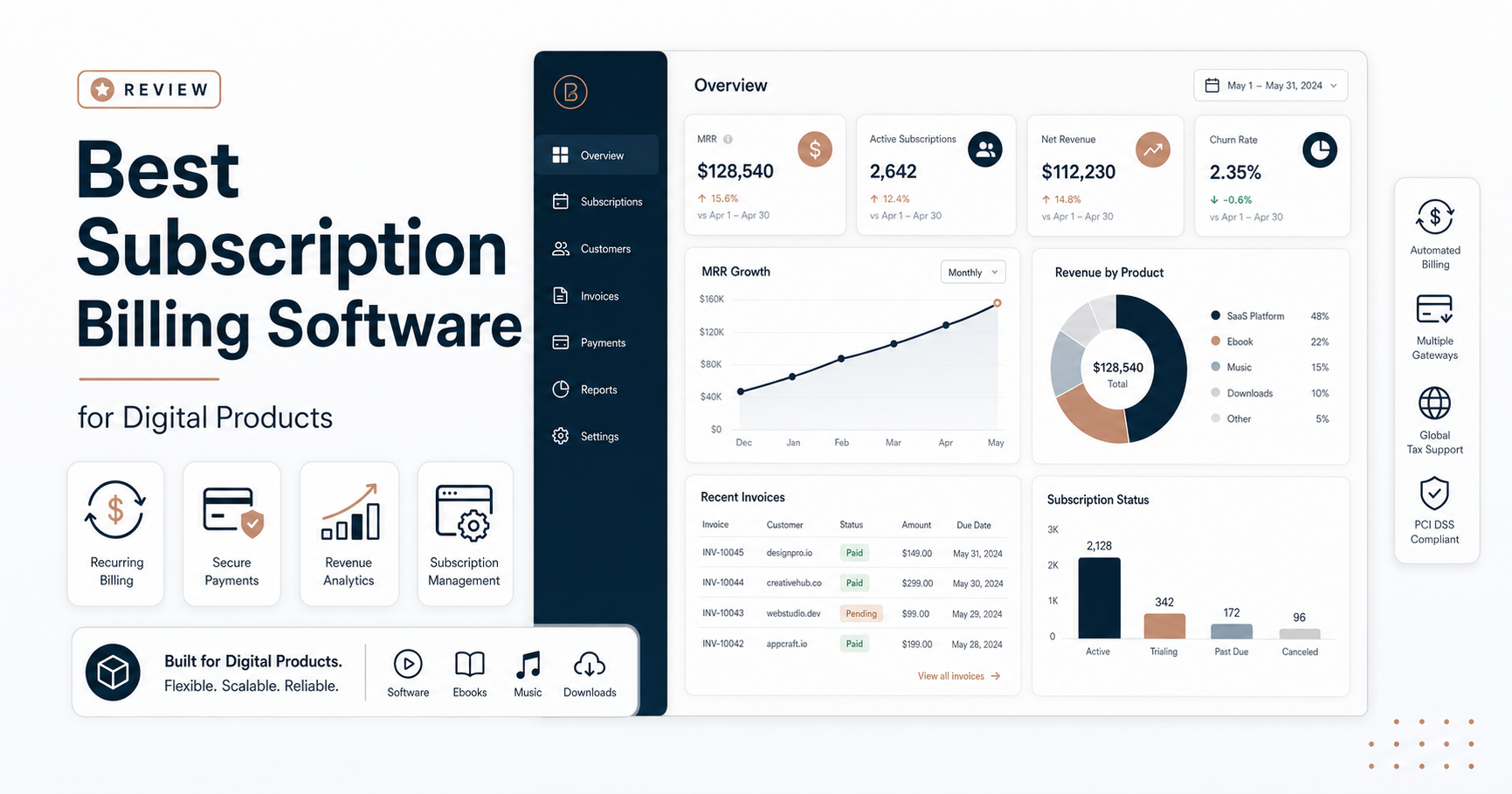
Best Subscription Billing Software for Digital Products
Introduction
In the rapidly evolving landscape of digital products and Software as a Service (SaaS), efficient and robust subscription billing software is no longer a luxury but a necessity. For business owners, founders, marketers, and IT professionals, selecting the right platform can significantly impact revenue growth, customer retention, and operational efficiency. This comprehensive guide delves into the world of subscription billing software, exploring its core functionalities, key considerations for selection, and a detailed comparison of leading solutions tailored for digital products.
Subscription billing software automates the entire process of charging recurring customers, managing their subscriptions, and handling associated financial workflows. As digital businesses scale, the complexities of pricing models, payment processing, revenue recognition, and customer lifecycle management can become overwhelming. A dedicated billing platform streamlines these operations, minimizes manual errors, and provides critical insights into subscription metrics, ultimately empowering businesses to focus on product innovation and market expansion.
Key Features of Best Subscription Billing Software
Choosing the ideal subscription billing software requires a thorough understanding of the features that drive success in a recurring revenue model. The most effective platforms offer a blend of flexibility, automation, and analytical capabilities.
Pricing Flexibility
Modern digital products often employ diverse and evolving pricing strategies. A robust billing solution must support:
- Various Pricing Models: Flat-rate, tiered, volume, seat-based, hybrid, and usage-based pricing.
- Add-ons and One-off Charges: Seamless integration of additional services or single purchases.
- Coupons and Discounts: Tools for promotional offers and flexible discounting.
- Trials and Billing Schedules: Configurable trial periods and diverse billing frequencies (monthly, annual, custom).
Platforms that allow non-technical users to easily configure and modify pricing models are invaluable for agile businesses.
Subscription Lifecycle Management and Proration
Managing the entire customer journey, from sign-up to cancellation, is crucial. Key capabilities include:
- Upgrades, Downgrades, Pauses, Reactivations, and Cancellations: Smooth handling of all subscription changes.
- Clear Rules for Mid-cycle Changes: Automated proration calculations to ensure fair and accurate billing during changes.
- Customer-Facing Invoice Clarity: Generating easy-to-understand invoices that reflect all adjustments.
- Entitlement Alignment: Ensuring that product access accurately matches the current subscription state.
Dunning Management and Revenue Recovery
Failed payments are an inevitable part of subscription businesses. Effective dunning management is critical for revenue recovery:
- Configurable Smart Retry Schedules: Automated retries based on reason codes and optimized timing.
- Customer Notifications: Customizable email templates and communication flows for payment reminders.
- Grace Periods and Account State Handling: Managing temporary access during payment issues.
- Card Updater Support: Automatically updating expired or changed card details.
Advanced dunning can significantly reduce involuntary churn and recover a substantial percentage of lost revenue.
Global Payments Readiness
As digital products reach a global audience, supporting international payments is paramount:
- Integration with Multiple Payment Gateways: Flexibility to optimize payment processing across regions.
- Multi-currency Pricing and Invoicing: Offering local currency options to customers worldwide.
- Customizable Checkout: Support for various payment methods, including cards, ACH, digital wallets (e.g., Apple Pay, Google Pay), and local schemes (e.g., SEPA, Alipay).
- SCA and 3D Secure (3DS) Strategy: Compliance with regional security regulations for recurring transactions.
Finance and Compliance
Ensuring financial accuracy and regulatory compliance is a core function of billing software:
- Invoice Numbering and Audit Trails: Maintaining clear records for financial audits.
- Automated Tax Calculation and Reporting: Handling sales tax, VAT, and other regional taxes.
- Revenue Recognition Workflows: Compliance with accounting standards like ASC 606 and IFRS 15.
- Data Exports and Accounting Integrations: Seamless integration with ERP and accounting systems (e.g., QuickBooks, NetSuite).
Analytics and Insights
Powerful analytics provide actionable intelligence for business growth:
- Key Subscription Metrics: Tracking MRR, Churn Rate, LTV, and Cohort Analysis.
- Failed Payment Rates and Recovery Performance: Monitoring and optimizing dunning effectiveness.
- Predictive Analytics: Forecasting churn and customer lifetime value to inform strategic decisions.
Top Subscription Billing Software Providers
Here’s a look at some of the leading subscription billing software providers, highlighting their strengths, typical use cases, and pricing models.
1. Stripe Billing
Overview: Stripe Billing is an extension of the widely used Stripe payment processing platform, offering robust features for recurring payments and subscription management. It’s particularly popular among developers and businesses already using Stripe for other payment needs.
Key Features: Flexible pricing models, developer-friendly APIs, smart retries for failed payments, comprehensive reporting, and global payment support.
Pros:
- Easy to set up and integrate, especially for existing Stripe users.
- Highly customizable through APIs.
- Strong global payment capabilities.
- Machine learning-powered dunning to reduce churn.
Cons:
- Can become expensive for high billing volumes.
- May require more technical expertise for advanced configurations compared to some other platforms.
Pricing: Stripe Billing offers a pay-as-you-go model (e.g., 0.7% of billing volume) or tiered monthly plans starting from around $620/month for up to $100,000 billing volume, with custom pricing for larger enterprises.
2. Chargebee
Overview: Chargebee is a comprehensive subscription management and billing platform specifically tailored for SaaS businesses. It focuses on automating the entire subscription lifecycle, from acquisition to retention.
Key Features: Flexible pricing, strong dunning, revenue recognition, extensive integrations with CRMs and accounting software, and marketing tools for subscriber retention.
Pros:
- All-in-one solution for subscription management and billing.
- Supports a wide range of pricing models and complex billing scenarios.
- Integrates with over 30 payment gateways.
- Built-in marketing tools to reduce churn and support upsells.
Cons:
- Can be more complex to set up initially due to its extensive features.
- Pricing can scale significantly with business growth.
Pricing: Chargebee offers a “Starter” plan (free for the first $250K cumulative billing, then 0.75% on billing), a “Performance” plan (around $7,188/year for up to $100K billing/month), and custom enterprise pricing.
3. Recurly
Overview: Recurly is a powerful subscription management and recurring billing platform designed for high-volume digital commerce. It emphasizes personalization and advanced features for revenue optimization.
Key Features: Highly customizable billing models, multi-currency and multi-language support, advanced dunning management with machine learning, and extensive integrations with CRMs and payment gateways.
Pros:
- Exceptional flexibility for complex billing models.
- Strong dunning capabilities to prevent churn and recover revenue.
- Developer-friendly API for deep customization.
- Supports a wide array of payment methods.
Cons:
- Users have reported that invoices are not always easily configurable.
- Customization of workflows and reports may require external development.
- May be less suited for very small businesses with simple needs.
Pricing: Recurly plans start from $220/month (with the first 3 months free), offering custom pricing for larger needs.
4. Maxio
Overview: Maxio (formerly Chargify and SaaSOptics) is an all-in-one billing and financial reporting platform built for B2B SaaS companies managing subscriptions at scale. It excels in handling complex revenue recognition and financial analytics.
Key Features: Subscription billing and invoicing, usage-based pricing, comprehensive revenue recognition (ASC 606/IFRS 15), payments and collections, and self-serve billing portals.
Pros:
- Strong focus on financial reporting and compliance.
- Excellent for businesses with complex revenue recognition needs.
- Automates signups, upgrades, renewals, and recurring billing workflows.
- Integrates well with ERPs like NetSuite and accounting platforms.
Cons:
- Some users note that NetSuite data syncs can be one-way.
- May require pairing with product-side tools for real-time in-product access changes.
- Not ideal as a standalone billing platform for simple subscription pricing models.
Pricing: Maxio typically offers custom pricing based on the specific needs and scale of the business.
5. Solidgate
Overview: Solidgate positions itself as a global payment infrastructure and platform, offering subscription billing alongside payment orchestration, multi-PSP routing, and advanced fraud prevention. It
excels in optimizing payment performance and handling international transactions.
Key Features: Subscription billing, payment orchestration, multi-PSP routing, global payment methods, advanced fraud prevention, and chargeback representment.
Pros:
- Optimized for global subscription businesses and international scaling.
- Strong focus on payment performance and revenue recovery.
- Comprehensive fraud prevention and chargeback management.
- Flexible integration with multiple payment gateways.
Cons:
- May be more focused on payment infrastructure than deep subscription management features compared to some competitors.
- Pricing details are not readily available and likely custom.
Pricing: Custom pricing, typically tailored to the specific needs and transaction volumes of global enterprises.
Conclusion
Choosing the best subscription billing software for your digital product is a strategic decision that can profoundly impact your business’s growth and profitability. The ideal platform will not only automate recurring payments but also provide the flexibility to adapt to evolving pricing models, manage the entire customer lifecycle, recover lost revenue through effective dunning, and ensure compliance with financial regulations. By carefully evaluating key features such as pricing flexibility, subscription lifecycle management, dunning capabilities, global payment readiness, financial compliance, and robust analytics, business owners, founders, marketers, and IT professionals can select a solution that aligns with their current needs and future aspirations. The platforms reviewed—Stripe Billing, Chargebee, Recurly, Maxio, and Solidgate—each offer distinct strengths,
catering to different business sizes, complexities, and strategic priorities. Investing in the right subscription billing software is an investment in sustainable growth, enhanced customer satisfaction, and operational excellence in the dynamic digital economy.