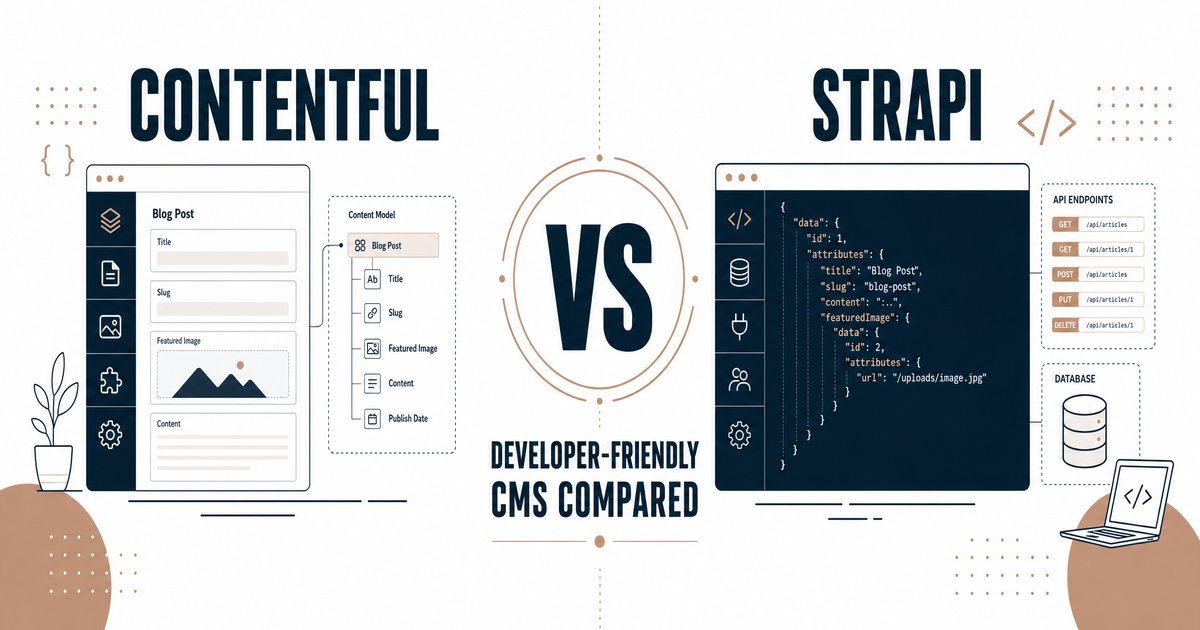
Contentful vs. Strapi: Developer-Friendly CMS Compared
Contentful vs. Strapi: A Developer-Friendly CMS Comparison for Business Leaders
In the rapidly evolving digital landscape, content management systems (CMS) are no longer just about publishing blog posts. Modern businesses require flexible, scalable, and developer-friendly solutions to deliver content across a myriad of channels, from websites and mobile apps to IoT devices. This demand has propelled headless CMS platforms to the forefront, offering a decoupled approach where content creation and presentation are separated. Among the leading contenders in this space are Contentful and Strapi, each offering distinct advantages for businesses seeking robust content infrastructure. This article provides a comprehensive, objective comparison of Contentful and Strapi, designed to assist business owners, founders, marketers, and IT professionals in making an informed decision for their digital strategy.
Key Features: A Deep Dive into Capabilities
Both Contentful and Strapi are powerful headless CMS solutions, yet they approach content management with different philosophies and feature sets. Understanding these nuances is crucial for aligning a platform with specific business and technical requirements.
Contentful: The Managed Cloud Solution
- Headless Architecture: As a fully managed service, Contentful abstracts away infrastructure concerns, allowing teams to focus purely on content and frontend development [4].
- Flexible Content Modeling: Users can define custom content types with a wide array of fields, enabling highly structured and reusable content. This flexibility supports complex data structures and omnichannel delivery [4].
- API-Driven: Contentful provides robust RESTful and GraphQL APIs for seamless integration with any frontend framework or digital channel. This API-first approach ensures content can be delivered anywhere [4].
- Multi-Channel Delivery: Contentful excels at distributing content across various platforms, including websites, mobile applications, and emerging digital touchpoints, all from a single content hub [4].
- Developer Tools: The platform offers comprehensive SDKs, CLI tools, and extensive documentation, empowering developers to build custom integrations and frontend experiences efficiently [4].
- Collaboration Tools: Built-in workflows, roles, and permissions facilitate seamless teamwork among content creators, editors, and developers, ensuring content governance and efficient publishing processes [4].
- Scalability & Reliability: Backed by a global Content Delivery Network (CDN), Contentful ensures rapid content deployment, high uptime, and robust scalability to handle growing content volumes and traffic [2]. It also features strong versioning and rollback capabilities, providing a safety net for content changes [2].
Strapi: The Open-Source, Self-Hostable Alternative
- Headless Architecture: Strapi provides a headless architecture that is both open-source and self-hostable, giving businesses complete ownership and control over their data and infrastructure [1].
- Customizable Content Modeling: Similar to Contentful, Strapi allows for the creation of highly customizable content types, fields, and relationships, enabling precise content structuring tailored to unique business needs [1].
- API-Driven: Strapi automatically generates REST or GraphQL APIs based on the defined content models, significantly reducing backend development time and allowing developers to connect to any frontend [1].
- Multi-Channel Delivery: Its decoupled nature ensures content can be delivered to any platform or device, offering flexibility in frontend technology choices like React, Angular, or Vue.js [1].
- Customization & Extensibility: A key differentiator for Strapi is its modular plugin system and the ability to fully control the codebase. This allows for extensive customization and the development of bespoke functionalities [1].
- Developer-Friendly: Built with Node.js, Strapi offers a modern development experience, simplifying API creation and management. It significantly reduces the time spent on backend coding [1].
- Admin Panel: Strapi features an intuitive and customizable admin panel, providing content creators and editors with the necessary tools to manage content effectively, from entry creation to media organization [1].
- Multi-Language Support: Built-in multilingual support facilitates the creation and management of content in various languages, crucial for businesses targeting global audiences [1].
- Role-Based Access Control (RBAC): Strapi includes robust RBAC capabilities, allowing administrators to define user roles and permissions, ensuring secure content management and data integrity [1].
Pricing: Understanding the Investment
The cost structure of Contentful and Strapi presents a significant divergence, largely due to their fundamental differences in deployment and service models.
Contentful Pricing
- Free Plan: Includes basic content management features, suitable for small teams or individuals exploring the platform [3].
- Paid Plans (Basic, Premium, Enterprise): These tiers offer increasing levels of features, user counts, API calls, and locales. Pricing can range from approximately $5,000 to $70,000+ per year, depending on the organization’s size, number of users, and specific feature requirements [3].
- Usage-Based: Costs are primarily determined by metrics such as API calls, content types, and the number of users, making it essential for businesses to accurately forecast their usage [3].
Strapi Pricing
- Open-Source & Self-Hostable: The core Strapi software is free to download and use, eliminating licensing fees. This makes it an attractive option for businesses looking to minimize software expenditure [1].
- Strapi Cloud: For those preferring a managed service, Strapi offers Strapi Cloud, a Platform-as-a-Service (PaaS) hosting solution with various paid plans. This provides convenience without the overhead of self-hosting [1].
- Enterprise Edition: Strapi also offers an Enterprise Edition for self-hosted deployments, which includes advanced features, dedicated support, and enhanced governance capabilities, catering to larger organizations with specific needs [1].
- Associated Costs: The main expenses for self-hosted Strapi typically involve server infrastructure, maintenance, security, and the development resources required for setup, customization, and ongoing management [1].
Pros and Cons: A Balanced Perspective
Evaluating the strengths and weaknesses of each platform provides a clearer picture of their suitability for different business contexts.
Contentful Advantages
- User-Friendly Interface: Contentful is often praised for its intuitive interface, making it accessible for non-technical content editors [2].
- Managed Service: As a cloud-based solution, Contentful handles infrastructure, updates, and security, reducing the operational burden on IT teams [4].
- Scalability and Reliability: Designed for enterprise-level operations, it offers high uptime and robust performance, backed by a global CDN [2].
- Strong Ecosystem: A rich ecosystem of integrations, comprehensive documentation, and an active community provide ample resources and support [2].
- Rapid Deployment: Its managed nature allows for quicker setup and content deployment, accelerating time-to-market for digital initiatives [2].
Contentful Disadvantages
- Higher Pricing: The cost can be a significant barrier for small businesses or startups, especially when advanced features or higher usage tiers are required [2].
- Learning Curve for Advanced Features: While basic usage is straightforward, leveraging its full potential, particularly with complex content modeling, can have a steeper learning curve [2].
- API Rate Limits: Depending on the plan, API rate limits can be a concern for high-traffic applications, potentially necessitating optimization or an upgrade to a pricier plan [2].
- Less Control: As a managed service, businesses have less control over the underlying infrastructure and codebase compared to open-source alternatives [2].
Strapi Advantages
- Open-Source and Cost-Effective: The open-source nature significantly reduces initial costs, making it attractive for budget-conscious projects or those preferring to allocate resources to development rather than licensing [1].
- High Customization and Flexibility: Full control over the codebase and a modular plugin system allow for extensive customization to meet highly specific requirements [1].
- Self-Hostable: The ability to self-host provides complete data ownership, enhanced security control, and compliance with specific regulatory requirements [1].
- Developer-Friendly: Built with Node.js, it offers a modern development experience, with automatically generated APIs and a focus on developer productivity [1].
- Active Community: A growing and active developer community contributes to its continuous improvement, offering support and a wealth of shared knowledge [1].
Strapi Disadvantages
- Learning Curve for Non-Developers: While the admin panel is intuitive, setting up, customizing, and maintaining Strapi requires development expertise, which can be a challenge for non-technical users [1].
- Hosting and Maintenance Responsibility: For self-hosted deployments, businesses are responsible for infrastructure, security, updates, and scaling, which demands in-house technical capabilities or external support [1].
- Smaller Plugin Ecosystem: Compared to more mature CMS platforms, Strapi’s plugin marketplace is still developing, meaning some functionalities might require custom development [1].
- No Out-of-the-Box Templates: Strapi focuses on backend content management, requiring businesses to build their own frontend or integrate with a framework, which adds initial development effort [1].
When to Choose Contentful vs. Strapi
The decision between Contentful and Strapi ultimately hinges on a business’s specific needs, technical capabilities, budget, and long-term strategy. Both are excellent headless CMS options, but they cater to slightly different priorities.
Choose Contentful if:
- You prioritize a fully managed, cloud-based solution that handles infrastructure and maintenance, allowing your team to focus on content and frontend development.
- Ease of use for content editors and marketers is a top priority, with less concern for deep technical customization of the core CMS.
- Your business requires enterprise-grade scalability, high reliability, and robust collaboration features out-of-the-box.
- You have a budget that accommodates a SaaS pricing model and are willing to pay for the convenience and reduced operational overhead of a managed service.
- Rapid deployment and a quicker time-to-market are critical for your digital projects.
Choose Strapi if:
- You prefer an open-source solution that offers complete control over your codebase, data, and hosting environment.
- Your team has in-house development expertise (Node.js, JavaScript) and desires extensive customization capabilities to build highly unique digital experiences.
- Cost-effectiveness is a primary concern, and you are comfortable with the responsibilities of self-hosting and managing your own infrastructure.
- You require a highly flexible and extensible platform that can be tailored precisely to complex or evolving project requirements through custom plugins and modifications.
- Data ownership, specific security protocols, or compliance requirements necessitate a self-hosted solution.
Conclusion
Both Contentful and Strapi represent the cutting edge of headless CMS technology, empowering businesses to deliver dynamic, omnichannel content experiences. Contentful shines as a robust, managed cloud solution, ideal for organizations seeking a streamlined, enterprise-ready platform with minimal infrastructure overhead. Its user-friendly interface and comprehensive feature set make it a strong choice for businesses prioritizing rapid content deployment and ease of use for diverse teams.
Conversely, Strapi stands out as a highly flexible, open-source alternative, offering unparalleled customization and control. It is particularly well-suited for developer-centric teams with the technical expertise and desire to self-host, build bespoke functionalities, and maintain full ownership of their content infrastructure. The choice between these two powerful platforms ultimately depends on a careful evaluation of your project’s specific technical requirements, budget constraints, team capabilities, and long-term strategic goals. By weighing the unique strengths and considerations of Contentful and Strapi, businesses can select the CMS that best aligns with their vision for a future-proof digital presence.