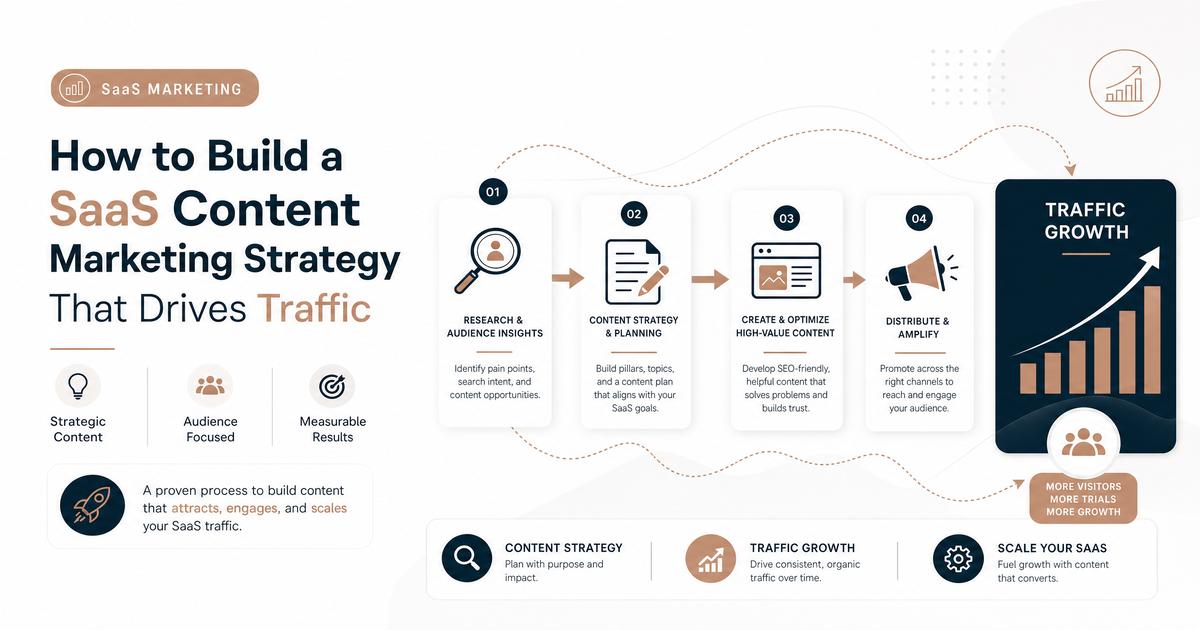
How to Build a SaaS Content Marketing Strategy That Drives Traffic
Introduction to SaaS Content Marketing
In the highly competitive Software as a Service (SaaS) landscape, standing out requires more than just a great product. It demands a strategic approach to attracting, engaging, and converting your target audience. This is where a robust SaaS content marketing strategy comes into play. Unlike traditional marketing, which often relies on disruptive advertising, content marketing focuses on creating and distributing valuable, relevant, and consistent content to attract and retain a clearly defined audience.
For SaaS companies, content marketing is not just about driving traffic; it is about building trust, establishing authority, and guiding potential customers through a complex buyer’s journey. A well-executed strategy can significantly reduce customer acquisition costs (CAC), increase customer lifetime value (CLTV), and foster long-term loyalty. In this comprehensive guide, we will walk you through the essential steps to build a SaaS content marketing strategy that not only drives high-quality traffic but also converts visitors into paying subscribers.
Step 1: Define Your Target Audience and Buyer Personas
The foundation of any successful content marketing strategy is a deep understanding of your audience. Without knowing who you are writing for, your content will likely miss the mark, resulting in wasted resources and missed opportunities.
Create Detailed Buyer Personas
Start by developing detailed buyer personas. These are semi-fictional representations of your ideal customers based on market research and real data about your existing customers. When creating personas for a SaaS product, consider the following elements:
- Demographics: Age, gender, location, and education level.
- Professional Details: Job title, industry, company size, and decision-making authority.
- Pain Points: What challenges are they facing that your software can solve?
- Goals: What are their primary objectives in their role?
- Information Sources: Where do they go to learn and find solutions (e.g., blogs, LinkedIn, industry forums)?
By understanding these factors, you can tailor your content to address their specific needs and position your SaaS product as the ultimate solution.
Step 2: Set Clear and Measurable Goals
Before creating content, you need to define what you want to achieve. Setting clear, measurable goals will help you track your progress and determine the return on investment (ROI) of your content marketing efforts.
Align Content Goals with Business Objectives
Your content marketing goals should align with your broader business objectives. Common goals for SaaS companies include:
- Brand Awareness: Increasing website traffic, social media followers, and brand mentions.
- Lead Generation: Capturing email addresses through gated content, webinars, and newsletter sign-ups.
- Customer Acquisition: Driving free trial sign-ups, demo requests, and ultimately, paid subscriptions.
- Customer Retention: Educating existing users on how to get the most out of your product to reduce churn.
Use the SMART framework (Specific, Measurable, Achievable, Relevant, Time-bound) to set your goals. For example, instead of saying “increase website traffic,” a SMART goal would be “increase organic blog traffic by 30% over the next six months.”
Step 3: Conduct Comprehensive Keyword Research
Keyword research is the process of identifying the terms and phrases your target audience uses when searching for solutions online. It is a critical component of SEO and ensures that your content is discoverable by search engines.
Identify High-Intent Keywords
For SaaS companies, it is essential to target keywords across the entire marketing funnel:
- Top of the Funnel (ToFu): Informational keywords where users are looking for answers to broad questions (e.g., “how to improve team collaboration”).
- Middle of the Funnel (MoFu): Consideration keywords where users are evaluating different solutions (e.g., “best project management software”).
- Bottom of the Funnel (BoFu): Transactional keywords where users are ready to make a purchase decision (e.g., “Asana vs. Trello comparison”).
Use tools like Ahrefs, SEMrush, or Google Keyword Planner to identify relevant keywords with a good balance of search volume and keyword difficulty. Focus on long-tail keywords, as they often have lower competition and higher conversion rates.
Step 4: Map Content to the Buyer’s Journey
The SaaS buyer’s journey is typically longer and more complex than in other industries. Your content strategy must cater to prospects at every stage of this journey, guiding them smoothly from awareness to decision.
Content Types for Each Stage
Different types of content work best at different stages of the funnel:
| Funnel Stage | User Intent | Recommended Content Types |
|---|---|---|
| Awareness (ToFu) | Seeking information and solutions to a problem. | Blog posts, infographics, educational videos, podcasts. |
| Consideration (MoFu) | Evaluating specific solutions and comparing options. | Ebooks, whitepapers, webinars, case studies, template downloads. |
| Decision (BoFu) | Ready to purchase and looking for validation. | Product comparisons, ROI calculators, free trials, live demos, customer testimonials. |
| Retention | Maximizing value from the purchased product. | Knowledge base articles, feature updates, user communities, advanced tutorials. |
By mapping your content to these stages, you ensure that you are providing the right information at the right time, increasing the likelihood of conversion.
Step 5: Create High-Quality, Engaging Content
With your audience, goals, keywords, and funnel mapped out, it is time to start creating content. In the SaaS industry, quality trumps quantity. Your content must be authoritative, well-researched, and genuinely helpful.
Focus on Originality and Value
To stand out in a crowded market, avoid simply regurgitating what is already out there. Instead, bring a unique perspective to your content. Here are a few ways to add value:
- Share Original Data: Conduct surveys or analyze your own user data to publish original research reports. Data-driven content is highly linkable and establishes your brand as an industry leader.
- Interview Subject Matter Experts (SMEs): Feature insights from internal experts or industry thought leaders to add credibility and depth to your articles.
- Provide Actionable Advice: Do not just discuss theoretical concepts. Give your readers practical, step-by-step instructions they can implement immediately.
- Use Clear Formatting: Make your content easy to read by using short paragraphs, bullet points, bold text, and clear headings.
Step 6: Optimize for Search Engines (SEO)
Creating great content is only half the battle; you also need to ensure it ranks well on search engine results pages (SERPs). On-page SEO is crucial for driving organic traffic to your SaaS website.
On-Page SEO Best Practices
When publishing your content, pay attention to the following SEO elements:
- Title Tags and Meta Descriptions: Craft compelling titles and meta descriptions that include your target keyword and encourage users to click.
- URL Structure: Keep your URLs short, descriptive, and keyword-rich (e.g., yourdomain.com/saas-content-marketing-strategy).
- Internal Linking: Link to other relevant pages on your website to keep users engaged and help search engines understand your site structure.
- External Linking: Link to authoritative external sources to back up your claims and improve the credibility of your content.
- Mobile Optimization: Ensure your content is fully responsive and provides a seamless reading experience on mobile devices.
Step 7: Distribute and Promote Your Content
Even the best content will not drive traffic if no one knows it exists. A robust distribution strategy is essential for getting your content in front of your target audience.
Leverage Multiple Channels
Do not rely solely on organic search. Promote your content across various channels to maximize its reach:
- Email Marketing: Share your latest blog posts, ebooks, and webinars with your email subscribers. Segment your list to ensure you are sending relevant content to the right people.
- Social Media: Promote your content on platforms where your audience hangs out, such as LinkedIn, Twitter, and Facebook. Tailor your messaging for each platform.
- Content Syndication: Republish your content on platforms like Medium, LinkedIn Articles, or industry-specific publications to reach a broader audience.
- Paid Advertising: Use paid channels like Google Ads, LinkedIn Ads, or Facebook Ads to boost high-performing content and drive targeted traffic.
- Community Engagement: Share your content in relevant online communities, such as Reddit, Quora, or specialized Slack groups. Be sure to provide value and avoid coming across as overly promotional.
Step 8: Measure, Analyze, and Iterate
A successful SaaS content marketing strategy is never truly finished. It requires continuous monitoring, analysis, and optimization to ensure you are meeting your goals and adapting to changes in the market.
Track Key Performance Indicators (KPIs)
Regularly review your analytics to track the performance of your content. Key metrics to monitor include:
- Traffic Metrics: Page views, unique visitors, and organic search traffic.
- Engagement Metrics: Time on page, bounce rate, and social shares.
- Conversion Metrics: Lead generation rate, email sign-ups, free trial registrations, and customer acquisition cost (CAC).
- SEO Metrics: Keyword rankings, backlinks, and domain authority.
Use tools like Google Analytics, Google Search Console, and your marketing automation platform to gather this data. Identify which pieces of content are performing well and which are underperforming. Use these insights to refine your strategy, update old content, and create more of what resonates with your audience.
Conclusion
Building a SaaS content marketing strategy that drives traffic and generates leads is a long-term investment. It requires a deep understanding of your audience, clear goals, comprehensive keyword research, and a commitment to creating high-quality, valuable content. By mapping your content to the buyer’s journey, optimizing for search engines, and implementing a robust distribution plan, you can establish your SaaS brand as an industry authority and build a sustainable engine for growth.
Remember that content marketing is an iterative process. Continuously measure your results, analyze your performance, and adapt your strategy to stay ahead of the competition. If you are ready to take your SaaS marketing to the next level, start by auditing your existing content and identifying gaps in your funnel. With dedication and a strategic approach, your content marketing efforts will yield significant returns, driving both traffic and revenue for your SaaS business.
Ready to optimize your SaaS marketing stack? Explore our comprehensive reviews and comparisons of the best marketing automation tools on SaaSSync Pro to find the perfect software to support your content strategy and accelerate your growth.